
What Paychex WISE Signals About the Future of Small Business HR
June 3, 2026
Recently on the At Work in America podcast, Trish Steed and I had the opportunity to sit down with Ryan Bergstrom , Chief Product Officer at Paychex, to discuss the company’s new AI platform, WISE, and the broader future of AI-powered HR and workforce technology for small and midsize businesses.
The conversation resonated long after we wrapped recording because it reinforced something I have been thinking about more and more over the last year. Namely, the future of workplace AI will not be defined only by massive and global enterprise transformation projects. Some of the most meaningful and immediate impacts will happen inside small and midsize organizations that are under enormous operational pressure and are looking for practical ways to simplify work, reduce stress, improve efficiency, and create more capacity to grow.
For years, conversations about AI in HR technology have largely revolved around large organizations with deep budgets, complex infrastructures, and dedicated transformation teams. Those companies absolutely matter, and many of them are making major investments in AI capabilities right now. But small businesses face a very different reality. They often operate with lean teams where leaders wear multiple hats every single day. The same person may be handling HR, payroll, operations, compliance, hiring, scheduling, finance, and employee relations all at once.
Ryan described this during the podcast as the “every hat” role, and I think that framing captures their reality and their challenges perfectly.
For these organizations, even small operational improvements can have an outsized impact. Saving several hours each payroll cycle matters to these companies. Avoiding compliance mistakes matters. Catching overtime issues before they spiral out of control is incumbent on many smaller organizations. And reducing administrative workload is an ongoing and often primary goal. These are not minor efficiency gains when you are operating a 10-person, 20-person, or 50-person business. They can materially affect profitability, employee experience, and the ability of a business owner to focus on customers and growth instead of constantly fighting administrative fires.
NEW AI Capabilities Announced on the Show
That is one reason why the announcement of Paychex WISE, as shared on the show by Ryan, should capture the attention of the small business HR leader and operator.
According to Paychex, WISE; Workforce Intelligence Strengthened by Expertise; is designed to bring AI-powered intelligence, workflow assistance, and increasingly agentic capabilities directly into HR and payroll operations for SMB organizations. The company describes it as part of a broader move toward an “agentic digital workforce,” where systems do more than simply record transactions and instead proactively help identify issues, guide decisions, and streamline work. You can read more on the official Paychex WISE announcement.
What stood out to me most during our discussion, however, was not simply the technology itself. It was the philosophy behind how the technology is being positioned. One of the strongest moments in the conversation came when Ryan described AI not as “artificial intelligence,” but as “augmented intelligence.” That distinction matters, especially to the SMB leader.
Reinforcing, not Replacing
Much of the public conversation around AI still gravitates toward replacement narratives and fears about automation taking over jobs. But for many SMB organizations, the immediate value proposition is much more grounded and practical. The goal is not necessarily replacing people. The goal is reducing administrative burden, simplifying workflows, surfacing important information sooner, and helping already-overextended business leaders operate more effectively.
Payroll is a perfect example.
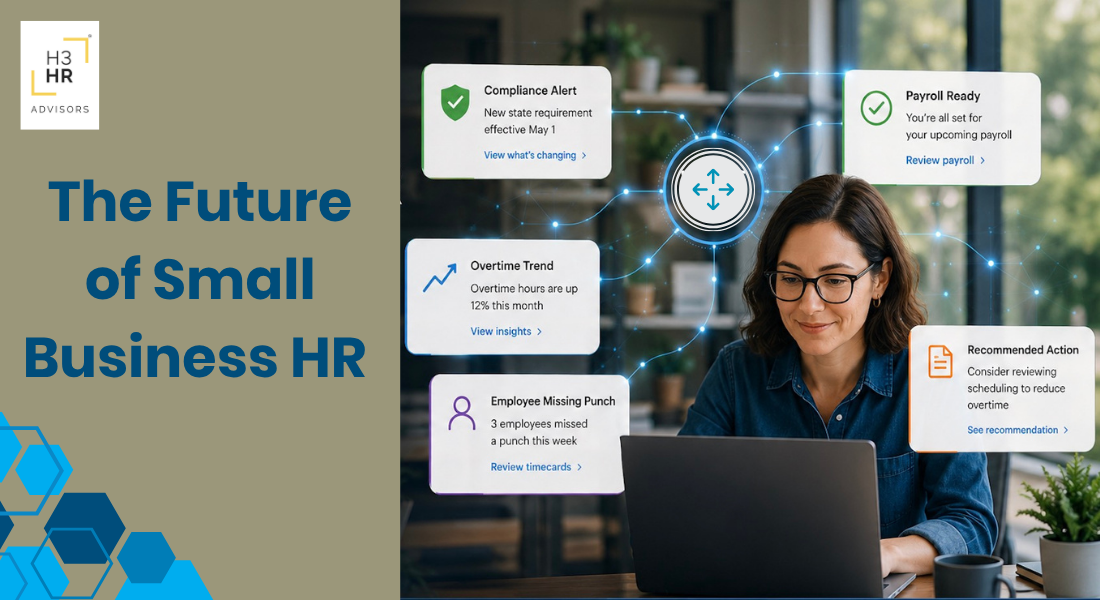
Historically, payroll has often been reactive. Problems are discovered at the last minute. Missing punches surface right before payroll runs. Overtime spikes go unnoticed until costs escalate. Compliance issues appear only after a business expands into a new state or jurisdiction. Managers scramble to resolve problems under tight deadlines, often while balancing numerous unrelated responsibilities.
During the discussion, Ryan described how Paychex is trying to fundamentally rethink that experience through WISE by using AI to proactively identify anomalies, notify managers earlier, guide users through corrective actions, and eventually automate portions of workflows while still keeping humans firmly in control of approvals and oversight.
“We think we can really revolutionize the payroll process and reduce the stress of payroll by helping businesses understand what’s changing, where anomalies exist, and by serving up a payroll that’s ready for them to go.”— Ryan Bergstrom, Chief Product Officer, Paychex
That is an important distinction because we increasingly believe the next generation of workplace systems will do more than simply automate tasks. The new solutions and platforms will orchestrate work.
This means they will identify issues before humans notice them and proactively surface recommendations. They will guide managers through processes in real time. They will operate conversationally and increasingly exist within the natural flow of work rather than requiring employees and managers to constantly navigate menus and disconnected systems.
HCM Solutions in the Flow of Work
One of the most interesting parts of our conversation centered on exactly that point. Ryan talked about a future where users interact with HR and payroll capabilities from wherever they are already working, whether that is Microsoft Teams, conversational interfaces, or other collaboration environments. That may sound like a subtle evolution, but I actually think it represents a very significant shift in enterprise software design, notably for the smaller organization’s benefit.
For decades, organizations have largely had to bend themselves around software. Employees were tasked with learning new systems. Managers had to adapt rigid workflows. And usually, businesses changed their processes to accommodate technology limitations. AI has the potential to reverse some of that dynamic.W e may finally be entering an era where software adapts more naturally to people instead of forcing people to adapt to software. And importantly, these experiences are no longer reserved only for the world’s largest, and well-funded and resourced enterprises.
Finally, the Democratization of Enterprise Technology
For years, one of the great promises of cloud technology and SaaS was the democratization of enterprise-grade capabilities. To some extent, that happened. But there has still often been a meaningful gap between the sophistication of technology available to Fortune 500 organizations and what smaller businesses could realistically access and implement. But now, AI may finally accelerate the closing of that gap.
That is one of the biggest signals I took away from this discussion. At the same time, the conversation also reinforced something else that I believe strongly: trust, security, and human oversight are becoming more important, not less, as AI capabilities expand.
Trust, Safety, and Data Security
HR and payroll systems operate in highly sensitive environments involving compensation, benefits, tax information, employee records, and compliance obligations. Organizations need confidence that AI systems are operating securely, transparently, and within clearly defined boundaries. Ryan emphasized that Paychex is approaching WISE with strong controls around permissions, approvals, auditability, and keeping humans in the loop before actions are finalized.
I think that balance is going to matter enormously across the HR technology landscape over the next several years. The organizations that succeed in AI will not simply be the organizations that move the fastest. They will be the organizations that build the most trust. And perhaps most interestingly, the rise of AI may actually increase the importance of human expertise in many areas of HR and workforce management. Throughout the discussion, Ryan repeatedly emphasized the combination of AI-powered technology alongside experienced HR advisors and service professionals. That combination of intelligent systems plus human expertise may ultimately prove to be one of the strongest models for the future of workplace technology.
Systems of Execution and Outcomes
At H3 HR Advisors, we have been focusing on the broader shift in enterprise technology from systems of record toward systems that increasingly help execute work. This conversation with Paychex felt like another meaningful example of that transition beginning to take shape in real-world applications. And importantly, it is happening in a market segment that often does not get enough attention in broader technology conversations. The future of AI at work is not only about the Fortune 500.
It is also about the local healthcare provider trying to manage a growing workforce while navigating compliance and scheduling pressures, the construction company balancing labor demands and operational complexity, or the restaurant group managing hourly employees across multiple locations. These organizations, and so many more in manufacturing, retail, or professional services, are simultaneously trying to scale the business while handling payroll, hiring, compliance, customer demands, and day-to-day operations all at once.
Those organizations are going to shape the future of work too. And increasingly, they may finally have access to technology experiences powerful enough to truly help them compete, grow, and operate with less friction and less stress. That is why this conversation felt important to H3 HR Advisors, and should feel important to you as well.
You can listen to the full discussion with Ryan Bergstrom from Paychex on the latest episode of At Work in America, where we dive deeper into AI, payroll innovation, workforce technology, and what the future may look like for SMB organizations navigating this next era of work.
How we can help
Led by Trish Steed and Steve Boese, H3 HR Advisors harnesses over 40 years of experience to delivery HCM insights and guidance to global organizations.
H3 HR Advisory services
By leveraging technology, analytics, and our deep industry knowledge we can help you to reposition your workforce and ensure that you have the right people with the right capabilities in the right roles to positively impact the growth of your business.
HR Happy Hour Podcast Network
Created in 2009, The HR Happy Hour Show is hosted by Steve Boese and Trish Steed and is the longest continuously running internet radio show and podcast on Human Resources, HR Technology, Talent Practices, Workplace and Leadership topics.
H3 HR Speaking Services
We work closely with every client to customize your content - keynotes, webinars, research, infographics, and buyer’s guides - to inspire, educate and inform the audience enabling you to reset and realign your organization for a talent-led breakthrough.
Get in touch
Talk to us today and find out how we can help you and your organization leverage HCM technology to attract, onboard, retain and manage top talent.