
The Six Workplace Stories That Defined the First Half of 2026
July 8, 2026
Summary
The first half of 2026 will likely be remembered as the moment artificial intelligence stopped being an emerging technology and became an organizational imperative. Across nearly every industry, AI moved beyond experimentation and into enterprise workflows. But looking back over the past six months, I don’t believe AI was actually the biggest story.
The bigger story was that organizations began redesigning themselves around AI.
That shift has implications far beyond technology. It is changing workforce strategy, organizational design, leadership, employee expectations, and the role of Human Resources itself. Looking back across six months of Workplace Minute episodes, as well as our other HR Happy Hour Media Network shows, and the hundreds of news stories and research reports we’ve analyzed; six themes stand out. Together, they tell us far more about where work is heading than any individual headline ever could.
Looking Beyond the Headlines
One of the goals I’ve always had for Workplace Minute is to do more than summarize the news. There are plenty of places to find headlines. The greater challenge for leaders is understanding which headlines represent lasting change and which simply reflect the news cycle. And ultimately, their challenge is how to respond to changes in technology, culture, the economy, and society.
During the first half of 2026, we explored topics ranging from AI infrastructure and labor market shifts to worker trust, financial wellbeing, organizational redesign, age inclusion, skilled trades, and the changing relationship between employers and employees. At first glance these may appear to be unrelated stories.
They aren’t.
Viewed together, they reveal an important pattern. Organizations are no longer simply adopting new technology. They are making fundamental decisions about how work itself will be organized during the AI era.
- AI Stopped Being a Technology Project
The biggest technology story of this year so far wasn’t the release of another model or another chatbot. It was the realization that AI had become embedded in enterprise infrastructure.
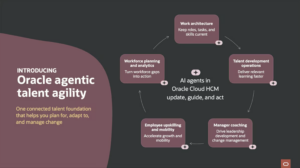
Throughout the year on The Workplace Minute, we’ve examined billion-dollar investments in AI infrastructure, the rapid expansion of data centers, Oracle’s vision for embedded enterprise AI, the emergence of Model Context Protocol, growing enterprise demand for agentic AI, and the skilled trades workforce required to build the physical infrastructure supporting this new economy.
Taken together, these developments tell a consistent story. AI is no longer an innovation project owned by IT. AI is becoming part of the operating model of the enterprise itself. That changes the conversation entirely. The question is no longer whether organizations should adopt AI. The question is how they redesign themselves around it.
- Organizations Began Reallocating Investment
One of the more revealing trends this year wasn’t simply increasing AI spending. It was where organizations found the money to fund those growing investments.
Earlier this year we discussed Teradata’s decision to redirect compensation dollars toward AI investments. We examined companies pausing traditional workforce investments while increasing spending on technology and specialized AI talent. We also explored comments from executives who openly acknowledged that AI had become the organization’s highest strategic investment priority.
These examples illustrate a broader shift in capital allocation. Organizations increasingly view AI as essential to future competitiveness. The challenge now is ensuring those investments strengthen, rather than weaken, employee confidence.
Technology creates capability but people create competitive advantage. The organizations that understand the difference will be the ones that outperform over the long term.
- Worker Confidence Became a Business Metric
Perhaps the most underappreciated story of the first half of 2026 wasn’t technological at all. It was psychological.
Throughout the year we discussed AI anxiety, slowing hiring, job search burnout, unemployment benefits, financial wellbeing, declining worker confidence, and the uncertainty many employees feel about their future careers. We also devoted a three-part series to exploring how organizations can build trust during periods of rapid technological change.
Looking back, these weren’t separate conversations. They were different expressions of the same challenge.
Workers generally understand that change is inevitable. What they struggle with is uncertainty. When organizations clearly explain how technology creates opportunity, employees become far more willing to embrace change. When communication is absent, uncertainty fills the gap.
Worker confidence is becoming a strategic business asset.
- HR’s Job Description Changed
For years, HR technology conversations centered on systems, automation, and efficiency. That is changing.
Increasingly, HR leaders are being asked to redesign work itself.
We’ve discussed workforce operating systems, agentic AI, digital coworkers, enterprise platforms, organizational redesign, and the changing relationship between humans and intelligent systems. These conversations all point toward a broader evolution of the HR function.
Tomorrow’s HR leaders won’t simply implement technology. They will help redesign organizations. That may become one of the profession’s most important responsibilities during the coming decade.
- Trust Emerged as the Currency of AI Adoption
If there has been one recurring theme throughout Workplace Minute this year, it has been trust.
Whether discussing layoffs, AI implementation, Pride Month, age inclusion, worker safety, financial wellbeing, or our recent conversation about the American Dream at Work, one question consistently surfaced:
Do workers believe their organizations are creating opportunity, or simply demanding adoption?
This distinction matters because technology adoption ultimately depends on trust.
Employees who trust leadership are more willing to learn, experiment, and embrace new ways of working. Employees who lack trust often resist change, not because they oppose technology, but because they are uncertain about what it means for them.
Trust isn’t a soft, fuzzy metric. It is becoming a strategic capability.
- Opportunity Became the New Measure of Leadership
As I reflected on the first half of the year, one final theme stood above the others.
Opportunity.
Our recent Independence Day Workplace Minute explored the idea that the future of work should ultimately be measured by whether organizations continue expanding opportunity for people. Looking back across the year’s conversations, I believe that idea connects nearly everything we’ve discussed.
Organizations investing in AI have an opportunity to create better work. Organizations redesigning jobs have an opportunity to make careers more meaningful. Organizations embracing new technologies have an opportunity to make those technologies accessible to more people. Leadership in the AI era will increasingly be judged not simply by financial performance or productivity gains, but by whether organizations continue creating opportunity for employees to learn, contribute, grow, and succeed.
That may become the defining leadership challenge of the next decade.
Three Questions I’ll Be Watching During the Second Half of 2026
Rather than making predictions, I’d encourage leaders to think about three questions.
First, which organizations will redesign work instead of simply automating it?
Adding AI to existing processes may improve efficiency. Redesigning work around the strengths of both people and technology has the potential to fundamentally improve organizational performance.
Second, which organizations will continue investing in people while investing aggressively in AI?
The companies that successfully balance technological innovation with human development may establish a durable competitive advantage that extends well beyond the AI cycle itself.
Third, which organizations will earn employee confidence instead of simply asking for it?
Trust cannot be mandated. It must be built through transparency, communication, fairness, and visible investment in people.
The Bigger Story
Looking back, I don’t believe the biggest story of the first half of 2026 was artificial intelligence.
I believe it was organizational choice.
Every leadership team is making decisions about what kind of company it wants to become. AI is accelerating those decisions, but it isn’t making them.
The second half of the year won’t be remembered because AI models became faster or more capable. It will be remembered because organizations began demonstrating what they truly value. The future of work has never been solely about technology. It has always been about leadership.
And leadership is ultimately measured by the choices we make about people.
Author
Categories
Tags
Share
How we can help
Led by Trish Steed and Steve Boese, H3 HR Advisors harnesses over 40 years of experience to delivery HCM insights and guidance to global organizations.
H3 HR Advisory services
By leveraging technology, analytics, and our deep industry knowledge we can help you to reposition your workforce and ensure that you have the right people with the right capabilities in the right roles to positively impact the growth of your business.
HR Happy Hour Podcast Network
Created in 2009, The HR Happy Hour Show is hosted by Steve Boese and Trish Steed and is the longest continuously running internet radio show and podcast on Human Resources, HR Technology, Talent Practices, Workplace and Leadership topics.
H3 HR Speaking Services
We work closely with every client to customize your content - keynotes, webinars, research, infographics, and buyer’s guides - to inspire, educate and inform the audience enabling you to reset and realign your organization for a talent-led breakthrough.
Get in touch
Talk to us today and find out how we can help you and your organization leverage HCM technology to attract, onboard, retain and manage top talent.