
The Next Great Challenge of Artificial Intelligence is Trust
July 2, 2026
Artificial intelligence has become one of the most discussed topics in business, yet much of the conversation continues to revolve around a surprisingly narrow question.
Will AI replace workers?
It is an understandable question. Every week brings another announcement of a new AI model, another company investing billions of dollars in AI infrastructure, another executive describing productivity gains, or another headline warning about the future of jobs. Taken together, those stories naturally lead people to wonder whether we are approaching a moment of widespread technological unemployment.
But after spending the last several months studying labor market data, enterprise AI adoption, and the decisions organizations are making about work, I have become convinced that we are asking the wrong question.
The more important question is not whether AI will replace workers. It is: How will AI reshape the relationship between organizations and the people who work for them?
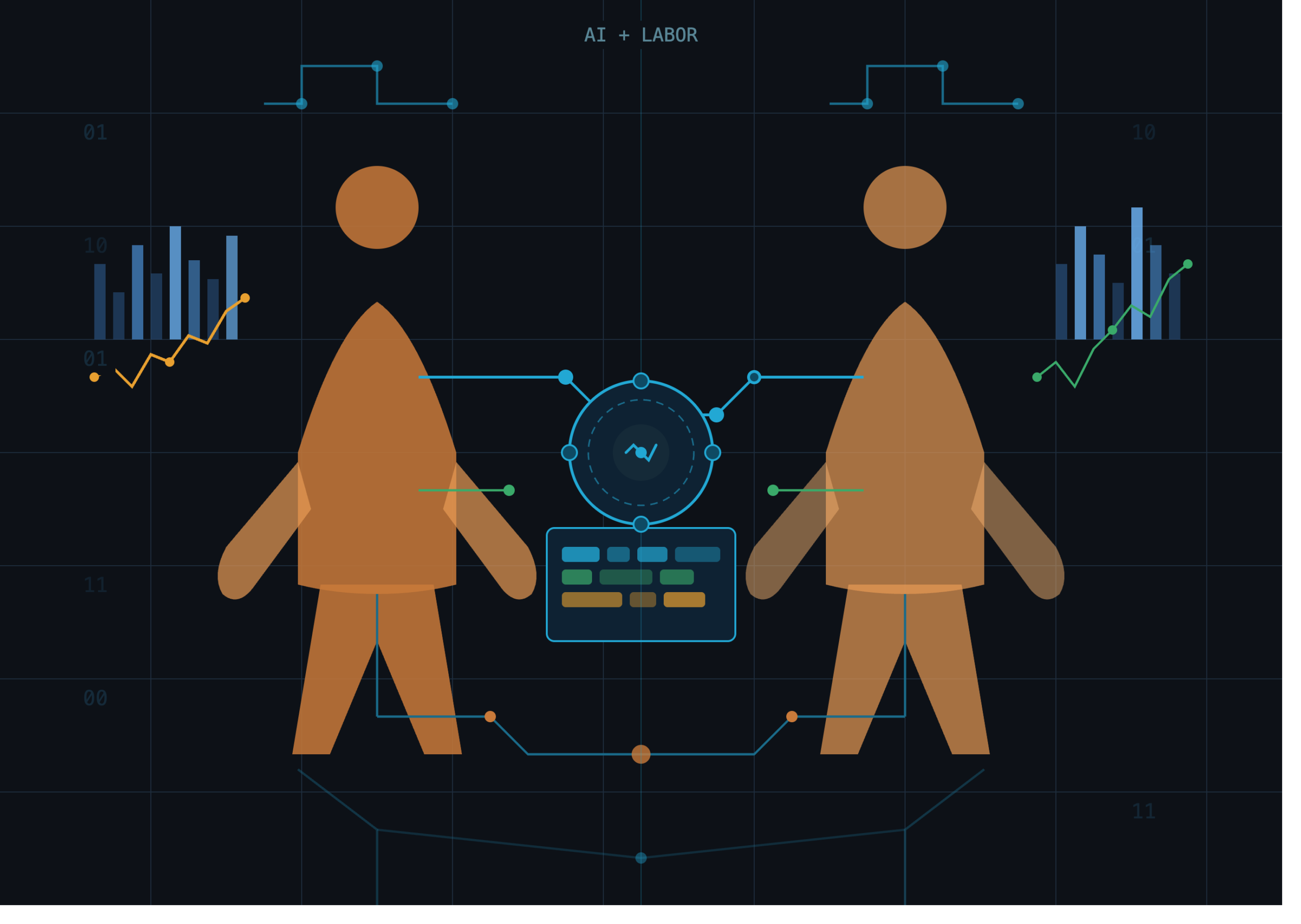
That realization became the foundation for a recent three-part Workplace Minute series, which explored AI’s impact on the labor market from three different perspectives. Together, they tell a story that is both more complex, nuanced, and ultimately more important than many of today’s headlines suggest.
AI Isn’t Eliminating the Labor Market. It’s Dividing It.
The first episode in the series challenged one of the most common assumptions surrounding artificial intelligence.
Despite years of extraordinary investment in AI, we have not (yet) seen the kind of widespread unemployment many experts have predicted. Labor markets in the United States remain relatively resilient. At the same time, research increasingly shows that workers with AI-related skills are becoming substantially more valuable, while jobs centered on routine information processing are experiencing growing pressure from automation and changing organizational expectations.
This suggests that AI is not producing one labor market. It is producing two.
One group of workers is discovering that AI amplifies their expertise, allowing them to become more productive and more valuable. Another group finds itself working in roles that organizations increasingly view as candidates for automation, consolidation, or redesign.
This distinction matters because it reframes the challenge. Rather than preparing for a world with dramatically fewer jobs, we should be preparing for a world where opportunity becomes increasingly uneven. Access to AI skills, learning opportunities, and organizational investment will likely become some of the most important determinants of career success over the next decade.
The Labor Market Looks Healthy. Workers Don’t Feel Healthy.
The second episode of the series explored what may be one of the most overlooked workforce stories of 2026.
Traditional labor market indicators continue to paint a picture of relative stability. Unemployment remains historically low. Employers continue to hire. By most economic measures, the labor market appears remarkably resilient. Yet workers and jobseekers tell a very different story.
Many employees report feeling less secure than they did just a few years ago. Experienced professionals describe increasingly difficult job searches. Entry-level workers struggle to establish careers. Employees who remain in their current roles often speak openly about uncertainty surrounding restructuring, AI adoption, and organizational change.
These feelings are not captured by unemployment statistics. Employment data measures outcomes, but it does not measure labor force confidence.
And confidence influences behavior. Workers who are uncertain about their future become less likely to change jobs, invest in new opportunities, make major financial decisions, or embrace organizational change. In many ways, worker confidence may become one of the defining workforce indicators of the AI era.
The Future of Work Is a Leadership Decision
The final episode in our series on AI and the Labor Market asked what I believe is the question leaders should be asking today.
If artificial intelligence is becoming embedded in hiring, workforce planning, performance management, learning, scheduling, customer service, software development, and countless other business processes, what responsibilities do organizations have to the people whose work is being transformed?
Too often, enterprise AI conversations focus almost exclusively on productivity. They seek to influence measures like:
How many hours can we save? How many tasks can we automate? How much cost can we remove?
Those are important business questions. But employees are asking entirely different questions. They wonder How will AI affect my career? Will becoming more productive create new opportunities for me? Or will my increased productivity simply convince the organization that it needs fewer people?
Those questions are fundamentally about trust.
Organizations that communicate openly, invest in workforce development, explain how AI will be used, and demonstrate that employees have a meaningful place in the future they are building will likely earn something far more valuable than short-term productivity gains. They will earn confidence and loyalty in a labor market where both are in short supply.
The Real Competitive Advantage
History suggests that every major technological revolution eventually becomes less about technology itself and more about how people choose to use it. Artificial intelligence will almost certainly continue becoming more capable. That is no longer the most interesting question.
The more important question is whether organizations will use those capabilities to create better work, stronger careers, and greater opportunity—or simply accomplish the same work with fewer people.
Technology cannot answer that question. Organizations can. Leadership can.
This is why I believe the next competitive advantage will not simply belong to organizations with the best AI models or the largest technology budgets. It will belong to organizations that earn the trust of their workforce while navigating one of the most significant workplace transformations in generations.
The future of work is not predetermined by artificial intelligence. It will be shaped by the choices leaders make about how artificial intelligence is deployed, how workers are prepared for change, and how the benefits of increased productivity are ultimately shared.
The future of work is not simply a technology story. It is a leadership story. It is a trust story.
And above all, it is still a human story.
Thanks for reading and to listen to our special Workplace Minute series on the impact of AI on the Labor Market please visit hrhappyhour.net
How we can help
Led by Trish Steed and Steve Boese, H3 HR Advisors harnesses over 40 years of experience to delivery HCM insights and guidance to global organizations.
H3 HR Advisory services
By leveraging technology, analytics, and our deep industry knowledge we can help you to reposition your workforce and ensure that you have the right people with the right capabilities in the right roles to positively impact the growth of your business.
HR Happy Hour Podcast Network
Created in 2009, The HR Happy Hour Show is hosted by Steve Boese and Trish Steed and is the longest continuously running internet radio show and podcast on Human Resources, HR Technology, Talent Practices, Workplace and Leadership topics.
H3 HR Speaking Services
We work closely with every client to customize your content - keynotes, webinars, research, infographics, and buyer’s guides - to inspire, educate and inform the audience enabling you to reset and realign your organization for a talent-led breakthrough.
Get in touch
Talk to us today and find out how we can help you and your organization leverage HCM technology to attract, onboard, retain and manage top talent.