
HR Technology News Analysis: Paycom Expands the HCM Platform with Asset Management
July 23, 2026
Summary
Paycom has expanded its platform with the introduction of Asset Management, a new solution designed to automate the assignment, tracking, recovery, and reporting of company assets throughout the employee lifecycle. By leveraging decision logic and full-solution automation, the solution helps streamline workflows that traditionally require coordination across HR, IT, operations, and facilities teams. While the immediate benefits center on improving operational efficiency and reducing asset losses, the announcement also reflects a broader shift toward data consolidation and connected business processes, where the boundaries between HR, IT, operations, and finance continue to blur around shared workflows.
The News
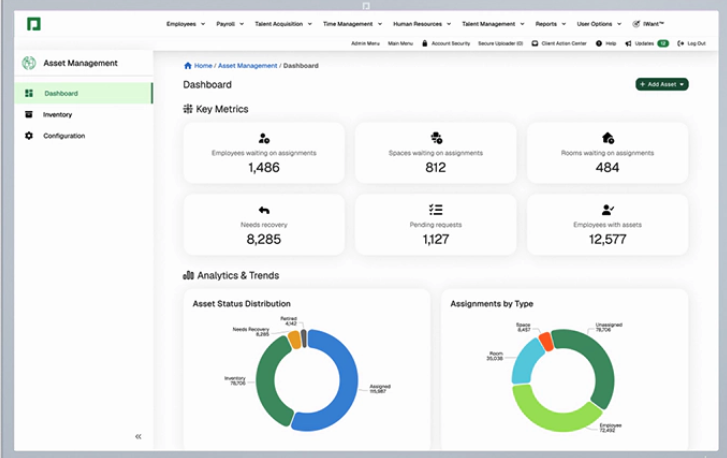
Paycom has introduced Asset Management, a new solution that enables organizations to manage the full lifecycle of company-issued assets from within the Paycom platform. The application allows employers to assign and track equipment such as laptops, mobile devices, tools, uniforms, and other company property, while also managing workspace and seating assignments, all through Paycom’s single employee database.
The solution automates many of the administrative processes that traditionally require coordination across HR, IT, facilities, and operations teams, extending Paycom’s broader approach to full-solution automation across interconnected workforce and operational workflows. Assets can be assigned automatically based on an employee’s role, location, or department, using decision logic to standardize onboarding workflows while reducing manual decision-making and providing managers and administrators with real-time visibility into asset ownership and status. As employees change roles or leave the organization, the platform also helps automate asset recovery, reducing the risk of lost equipment, and improving compliance with company policies.
In addition to operational automation, Asset Management includes reporting capabilities that provide organizations with a centralized view of assigned assets, outstanding returns, and workplace occupancy. Because the solution is built directly into Paycom’s single-database architecture, asset records remain connected to employee records throughout the employment lifecycle without requiring separate systems or manual reconciliation.
Rather than positioning Asset Management as a standalone IT asset tracking application, Paycom has integrated the capability directly into its broader human capital management platform. The result is a workflow that extends naturally from hiring and onboarding through internal movement and ultimately offboarding, connecting employee data with the physical resources employees need to perform their work.
Why This Matters
On the surface, asset management may not seem like a natural extension of a human capital management platform. Traditionally, tracking laptops, mobile devices, uniforms, tools, ID badges, and workspace assignments has fallen to IT, facilities, operations, or finance, often supported by separate systems designed specifically for those functions. Yet in practice, these activities are tightly connected to the employee lifecycle. Every hire, transfer, promotion, leave of absence, or termination triggers a series of coordinated actions that extend well beyond HR.
As organizations have become more distributed and work has become increasingly digital, managing those handoffs has grown more complicated. A single onboarding event may require HR to complete hiring paperwork, IT to provision technology, facilities to assign workspace, security to issue credentials, and finance to account for company-owned assets. When those processes are managed across disconnected systems, organizations often rely on emails, spreadsheets, help desk tickets, and manual follow-up to ensure nothing falls through the cracks. The result is unnecessary administrative effort, inconsistent employee experiences, and increased risk of lost assets or compliance gaps.
Asset Management addresses a practical operational challenge, but it also reflects a broader shift occurring across enterprise software. Organizations are placing greater value on platforms that connect work across functional boundaries rather than reinforcing them. Instead of viewing employee data, operational data, and asset information as separate domains owned by different departments, leading software providers are increasingly bringing those workflows together around a common record of the employee.
That shift is becoming even more important as AI and workflow automation matures. Intelligent systems can only automate business processes effectively when they have visibility into the complete workflow, and full set of data, not just one department’s portion of it. Bringing operational processes like asset management into the same platform as core workforce data reduces friction, improves visibility, and creates new opportunities for automation that span the entire employee lifecycle.
Our Analysis
As a distinct set of capabilities, Asset Management appears to be a logical product extension that helps employers solve a common operational challenge. Viewed in the broader context of where enterprise software is heading, however, the announcement signals something more significant. It reflects the continuing evolution of the HCM platform from a system focused primarily on HR administration into a platform that increasingly supports the broader flow of work across the enterprise.
For decades, enterprise software has largely mirrored organizational structures. HR systems managed people, IT systems managed technology, finance systems managed budgets, and facilities systems managed physical workplaces. Those distinctions made sense when business processes were relatively independent. Today, however, the work itself rarely follows those same organizational boundaries. Nearly every significant employee event, whether hiring, onboarding, promotion, relocation, or separation, requires coordinated actions across multiple departments. The business process is continuous, even if the technology supporting it often is not.
That reality is becoming even more important as organizations invest in AI and intelligent automation. AI delivers its greatest value when it can orchestrate complete business processes rather than automate isolated tasks. An onboarding workflow, for example, becomes dramatically more valuable when the system not only creates an employee record, but also provisions equipment, assigns workspace, schedules required training, notifies managers, tracks outstanding tasks, and ultimately confirms that every required step has been completed. Those capabilities depend on connected data and integrated workflows rather than disconnected applications passing information between one another. Data consolidation becomes a prerequisite for intelligent automation across a broader range of business processes within a single platform.
This is where announcements like Paycom’s Asset Management become strategically important. By extending the employee record to include operational information such as company assets and workplace resources, Paycom is expanding the amount of business context available within its platform. That richer context creates opportunities for more intelligent automation, stronger reporting, and ultimately more capable AI experiences because the platform understands not only who an employee is, but also the resources, responsibilities, and workflows associated with that employee throughout their lifecycle.
We believe this represents one of the most important directions in enterprise HCM. The next generation of intelligent business platforms will be defined by how effectively they connect information, workflows, and decisions across traditional organizational boundaries. The future of enterprise software is likely to be organized around business outcomes rather than departmental ownership. This will enable organizations to automate increasingly complex processes that span HR, IT, operations, finance, and facilities. Asset Management is one example of that broader evolution, illustrating how the modern HCM platform is becoming an increasingly important foundation for intelligent enterprise operations.
Competitive Perspective
Paycom’s Asset Management announcement highlights a broader strategic question facing the HCM industry: How expansive should the modern HCM platform become? As AI and workflow automation reshape enterprise software, leading providers are taking different approaches to answering that question.
Some vendors continue to emphasize best-of-breed ecosystems, relying on deep integrations with specialized applications for IT asset management, facilities, service management, and other operational functions. In this model, the HCM platform serves as the system of record for workforce information while specialized platforms manage adjacent business processes. This approach provides organizations with flexibility and allows them to deploy targeted point solutions where required, but it also places greater importance on integration, data synchronization, and workflow orchestration across multiple systems. And it can often increase the Total Cost of Ownership (TCO) for the organization overall.
Other providers are pursuing a broader enterprise platform strategy, steadily expanding the scope of their HCM offerings into adjacent operational workflows. Rather than viewing employee data as separate from business operations, these vendors are increasingly bringing together workforce management, compliance, collaboration, operational processes, and now physical assets within a shared technology foundation. The objective is to reduce the number of disconnected workflows employees and administrators encounter throughout the workday by consolidating data and supporting automation across a broader range of business processes within a single platform. This approach also simplifies central administration, reduces IT complexity, and usually lowers the overall TCO.
Paycom’s introduction of Asset Management clearly aligns with this second philosophy. The announcement reinforces the company’s long-standing strategy of extending its single-database platform beyond traditional HR administration and into the operational activities that naturally accompany the employee lifecycle. Rather than positioning asset management as a separate operational system, Paycom is treating it as another business process that benefits from sharing the same employee record and workflow engine as payroll, talent management, and workforce management. The approach creates opportunities to apply consistent decision logic while reducing reliance on disconnected systems and manual administration.
Ultimately, each strategy will continue to be viable. Large global enterprises with extensive IT operations may continue to require specialized enterprise asset management platforms capable of managing complex hardware inventories, software licensing, endpoint security, and infrastructure at scale. At the same time, many organizations are looking for opportunities to simplify day-to-day operations by reducing the number of systems employees and managers interact with during routine workforce processes.
Over the next several years, the competitive landscape is likely to be shaped by which platforms create the most seamless end-to-end business experiences. As AI assumes responsibility for coordinating increasingly complex workflows, platforms that can connect people, processes, assets, and data with minimal friction will be well positioned to deliver greater business value than collections of loosely connected applications. The competitive advantage is shifting from “having more AI” to “giving AI more context.”
Bigger Picture
The introduction of Asset Management reflects the larger transformation underway across enterprise software. For years, organizations have invested in systems designed primarily to record transactions, store information, report on what happened, and support individual business functions. Human capital management systems managed employees. Financial systems managed budgets. IT systems managed technology assets. Each platform excelled within its own domain, while organizations relied on integrations and manual processes to connect work across departments.
That model is beginning to change.
The next generation of enterprise platforms is being designed not just to record what happened, but to identify, coordinate, and execute what happens next. Increasingly, enterprise applications are expected to initiate workflows, recommend actions, automate routine decisions, and orchestrate work that spans multiple business functions. In that environment, the value of a platform is determined by the breadth of its features, but also by the depth of its understanding of how the business operates – the context that is essential to run the business intelligently.
This shift also changes the role of AI within enterprise technology. Much of the discussion surrounding enterprise AI has focused on increasingly sophisticated models and conversational experiences. While those capabilities are important, long-term competitive advantage is likely to depend on the quality and richness of the business context available to the model. The most effective AI systems will not only answer prompted questions. They will understand employees, organizational structures, operational workflows, business policies, physical resources, and the relationships among them to coordinate work intelligently.
That is why announcements like Paycom’s Asset Management deserve our attention beyond their immediate functionality. Every additional business process, operational workflow, or enterprise data object that becomes part of a connected platform strengthens the foundation upon which intelligent automation and AI can operate. The objective is to build software that helps individual departments work more efficiently while establishing a technology platform capable of understanding how work flows across the organization and using that understanding to automate increasingly complex business outcomes.
Over the next several years, we expect the enterprise software market to compete more frequently on which platforms provide the richest operational context for AI. Organizations evaluating technology investments should ask not only what a platform can do today, but how effectively it connects people, processes, assets, and business knowledge to support the intelligent workflows that will define the next generation of work.
Conclusion
Paycom’s introduction of Asset Management is a practical enhancement that helps employers better manage company equipment, workspaces, and other physical resources throughout the employee lifecycle. Those capabilities alone will deliver meaningful operational value by reducing administrative effort, improving compliance, and minimizing the costs associated with lost or unreturned assets.
The larger story, however, lies beneath the product announcement itself. Asset Management demonstrates how the boundaries of the modern HCM platform continue to expand beyond traditional HR administration and into the operational workflows that define how organizations actually function. As AI, intelligent automation, and enterprise workflows become increasingly interconnected, platforms will drive value for customers by how completely they understand the business they are helping to run.
Viewed through that lens, Asset Management is more than another module. It reinforces a broader enterprise software trend toward data consolidation, decision logic, and full-solution automation within a single database. That richer context is becoming one of the most valuable assets organizations can build as they prepare for the next generation of intelligent enterprise software.
For HR and business leaders, that may be the most important takeaway from this announcement. The future value of enterprise technology will not only be derived from adding more AI. It will come from giving AI a more complete understanding of the people, processes, and resources that drive the business. Product announcements like this offer a view into how leading enterprise platforms are positioning themselves for that future.
Learn more about Paycom’s Asset Management here.
Follow H3 HR Advisors’ coverage of Paycom here.
How we can help
Led by Trish Steed and Steve Boese, H3 HR Advisors harnesses over 40 years of experience to delivery HCM insights and guidance to global organizations.
H3 HR Advisory services
By leveraging technology, analytics, and our deep industry knowledge we can help you to reposition your workforce and ensure that you have the right people with the right capabilities in the right roles to positively impact the growth of your business.
HR Happy Hour Podcast Network
Created in 2009, The HR Happy Hour Show is hosted by Steve Boese and Trish Steed and is the longest continuously running internet radio show and podcast on Human Resources, HR Technology, Talent Practices, Workplace and Leadership topics.
H3 HR Speaking Services
We work closely with every client to customize your content - keynotes, webinars, research, infographics, and buyer’s guides - to inspire, educate and inform the audience enabling you to reset and realign your organization for a talent-led breakthrough.
Get in touch
Talk to us today and find out how we can help you and your organization leverage HCM technology to attract, onboard, retain and manage top talent.