
The Evolution of Enterprise Applications: From Assistance to Autonomous Execution
July 21, 2026
Summary
For nearly three decades, enterprise software has evolved by helping people do work more efficiently. Oracle’s AI-native Builder Experience suggests the next chapter has arrived: enterprise applications that do more than support work; they actively coordinate and execute it. The implications extend well beyond technology, challenging HR leaders to rethink the design of work itself.
Introduction – From Systems of Record to Systems that Execute Work
For nearly three decades, enterprise software has evolved with a straightforward objective: to help people do their work more efficiently. Whether managing payroll, recruiting talent, processing invoices, or closing the financial books, business applications have largely served as systems of record. They captured transactions, organized information, and helped employees complete their work more effectively. Even as artificial intelligence entered the enterprise over the past several years, that fundamental relationship remained largely unchanged. AI became another tool to assist people, making it faster to search for information, draft content, process transactions, summarize documents, or generate recommendations.
Oracle’s latest announcement introducing its AI-native Builder Experience suggests the enterprise technology industry is approaching a more significant transition. Rather than focusing on AI as another assistant or chatbot embedded within an enterprise application, Oracle is architecting a future in which AI becomes part of the application itself, where AI is continuously monitoring business conditions, coordinating specialized AI agents, initiating workflows, and executing governed business processes while people provide oversight, judgment, and approvals. The vision extends beyond making workers more productive; it imagines enterprise applications that actively move work forward in pursuit of defined business outcomes.
The Evolution of Enterprise AI: From Assistance to Autonomous Execution
The past three years have brought a steady stream of enterprise AI announcements, each promising to transform how work gets done. While individual products and capabilities have differed, most innovations can be understood as part of a broader evolution. Each phase has expanded the role AI plays inside enterprise software, moving from answering questions to completing tasks and, increasingly, to coordinating and executing entire business processes.
The first phase introduced AI assistants. These tools were designed to help employees find information more quickly, answer questions about company policies, retrieve knowledge, or summarize documents. They reduced the time required to access information, yet the employee remained responsible for deciding what actions to take. AI informed the work, while people continued to perform it.
The second phase brought AI copilots, embedding generative AI directly into enterprise applications. Copilots drafted job descriptions, generated performance feedback, summarized recruiting conversations, recommended learning content, and helped managers complete routine administrative work. The relationship remained largely the same: AI accelerated individual tasks while humans retained responsibility for coordinating the broader process.
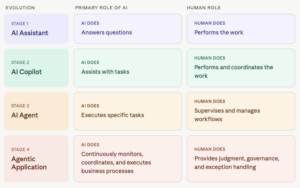
More recently, the third phase of development has seen enterprise software vendors introduce AI agents capable of executing work on behalf of users. Rather than simply making recommendations, these agents can complete defined tasks, route approvals, update records, initiate workflows, and communicate with other systems. This represents an important shift because AI moves beyond providing guidance and begins participating directly in business operations. Even so, most agents remain focused on discrete activities rather than the overall business objective.
Oracle’s latest announcement points toward what may become the next phase: Agentic Applications. In Oracle’s vision, the application itself becomes an active participant in achieving business outcomes. Rather than relying on a single assistant or agent, multiple specialized AI agents work together within a governed application to continuously monitor business conditions, identify priorities, coordinate actions, execute approved workflows, and involve people when judgment or oversight is required. As Oracle describes it, “Agents provide intelligence. Agent platforms provide infrastructure. Fusion Agentic Applications provide outcomes.”
This evolution represents a fundamental shift in how enterprise software is conceived. Instead of asking how AI can help employees use applications more effectively, vendors are beginning to ask how applications themselves can assume greater responsibility for advancing business objectives and driving outcomes. The evolution from assisting people with work to helping execute the work itself may ultimately become the defining characteristic of the next generation of enterprise technology.
From Enterprise Applications to Outcome Engines
Viewed in the context of this evolution, Oracle’s AI-native Builder Experience becomes much more than a low-code development tool. It represents Oracle’s attempt to redefine what an enterprise application is expected to do. Rather than simply building AI assistants that sit alongside existing business processes, Oracle is enabling customers to create what it calls Fusion Agentic Applications — applications designed around achieving business outcomes rather than supporting individual tasks.
That distinction is important. Traditional enterprise applications have generally been organized around functional modules such as recruiting, payroll, procurement, or financials. Users enter the application to complete work, populate data fields, and move from screen to screen as they execute individual transactions. Oracle’s vision shifts the focus away from screens and transactions toward business objectives. The application continuously monitors progress toward a defined outcome, identifies priorities, coordinates specialized AI agents, initiates workflows, and presents people with the decisions that require human judgment. Instead of waiting for users to move work forward, the application itself becomes an active participant in the process.
The examples Oracle highlights reinforce this philosophy. Rather than introducing another chatbot or digital assistant, it describes command-center applications focused on outcomes such as improving workforce operations, accelerating the financial close, managing sourcing activities, or helping sales organizations prioritize revenue opportunities. Each application combines multiple specialized AI agents, enterprise workflows, business rules, approvals, and real-time organizational context into a single operational environment designed to keep work moving continuously.
Perhaps the most revealing statement in Oracle’s documentation is also its simplest:
“Agents provide intelligence. Agent platforms provide infrastructure. Fusion Agentic Applications provide outcomes.”
That sentence captures Oracle’s broader strategic positioning. The company is arguing that the future competitive advantage in enterprise software will not come from building more capable individual AI agents. It will come from orchestrating many specialized agents within a governed enterprise application that understands business context, enforces policies, coordinates workflows, and measures success against meaningful organizational outcomes.
What is becoming increasingly clear is that enterprise software vendors are beginning to compete in a new paradigm. The conversation is shifting beyond how AI helps people complete work faster, and be measurably more productive, and toward how enterprise applications themselves can assume greater responsibility for advancing business results.
Why This Matters More for HR Than Almost Any Other Function
Among all enterprise functions, HR is ideally positioned to benefit from the next chapter of enterprise AI. Unlike many business systems, HR applications already sit at the intersection of people, organizational structures, policies, approvals, compliance requirements, identity management, and complex workflows. That combination creates an environment rich with organizational context which is the key ingredient agentic applications require to move beyond assisting work and begin coordinating it.
Consider how many HR processes today still depend on someone remembering to take the next step. A manager must initiate onboarding tasks for a new employee. A recruiter follows up with interview feedback. HR reminds leaders about overdue performance reviews. Compliance teams monitor required certifications or mandatory training. While many of these activities are supported by workflows and notifications, they still rely heavily on people to recognize what needs attention and keep the process moving forward.
An agentic application fundamentally changes that operating model. Rather than waiting for a manager or HR professional to log in and initiate the next action, the application continuously monitors the business objective itself. It recognizes when onboarding activities stall, identifies employees at risk of missing compliance requirements, detects signals that may indicate increased attrition risk, coordinates the appropriate AI agents to gather information, initiates approved workflows, and presents managers with the decisions that genuinely require human judgment. Routine coordination fades into the backgound, allowing people to focus on coaching, decision-making, and relationship building instead of administrative follow-up and basic troubleshooting.
This represents something more important and valuable than workflow automation. It represents the redesign of work itself. For years, HR technology has largely been evaluated by how efficiently it helped people complete transactions. The next generation of HR systems will be judged by how effectively they keep work moving without requiring constant human intervention. Success becomes less about helping employees and managers navigate software and more about reducing the amount of routine coordination people are required to perform in the first place.
That shift has important implications for leadership as well. As enterprise applications assume greater responsibility for monitoring work, coordinating activities, and executing routine processes, the manager’s role continues to evolve. Administrative oversight gives way to exception handling, coaching, ethical judgment, and decision-making in situations where context, empathy, and organizational priorities matter most. Likewise, HR’s opportunity expands beyond implementing AI tools to redesigning the work itself—determining which decisions should remain human, which can be delegated to AI, and what governance is required to ensure those systems operate fairly, transparently, and consistently.
Perhaps that is the most significant implication of Oracle’s announcement. The company is not simply describing a new way to build AI-powered applications. It is offering a vision of enterprise software that quietly assumes responsibility for coordinating much of the operational work that has traditionally occupied managers and HR teams. Whether that vision arrives in two years or five, it suggests the future of HR technology will be defined by more than how intelligently it answers questions but by how effectively it helps organizations achieve business outcomes.
Enterprise Context is the Competitive Advantage
For much of the past two years, the AI conversation has centered on models. Which large language model performs the best? Which assistant writes the best content? Which vendor has the most capable agent? Those remain important questions, but Oracle’s announcement suggests they may no longer be the most important ones.
As enterprise applications assume greater responsibility for coordinating and executing work, the competitive advantage increasingly shifts from the intelligence and utility of an individual model and toward the quality of the enterprise context surrounding it. To make sound decisions, AI must understand more than language and prompts. It needs access to organizational structures, business rules, employee records, approval hierarchies, security permissions, compliance policies, governance controls, historical transactions, and the relationships between them. Intelligence without context may produce impressive demonstrations. Intelligence grounded in enterprise context can execute real business processes.
That reality helps explain why Oracle repeatedly emphasizes the Fusion platform itself throughout its announcement. The company’s AI-native Builder Experience produces Fusion-native applications that inherit identity, security, business objects, workflows, approvals, governance, and auditability directly from the underlying platform. Rather than building those capabilities separately through custom integrations, Oracle argues that they should exist as part of the application from the outset.
This reflects a broader shift taking shape across enterprise technology. As organizations move from experimenting with AI to allowing AI to participate in operational decision-making, the value of the System of Record changes. These platforms are no longer simply repositories of organizational data. They become the operating environment in which AI reasons, coordinates work, executes approved actions, and maintains the governance necessary for enterprise trust.
For HR leaders, this distinction matters because people data is among the most interconnected and highly governed information inside any organization. Decisions about hiring, compensation, performance, learning, compliance, workforce planning, and employee development all depend on rich organizational context. The vendors best positioned to deliver the next generation of enterprise AI will need more than access to the most powerful models. They will need a deep understanding of the enterprise itself.
Conclusion: The Next Generation of Enterprise Applications
The history of enterprise software has largely been a story of increasing efficiency. The first Systems of Record digitized transactions and created a reliable source of enterprise data. Soon, workflow automation reduced manual effort and standardized business processes. More recently, AI assistants and copilots made individuals more productive by helping them find information, generate content, and complete routine tasks more quickly.
The next chapter in Enterprise Tech appears fundamentally different. Rather than helping people perform work more efficiently, enterprise applications are beginning to assume responsibility for coordinating and executing portions of that work themselves. They monitor business conditions continuously, identify priorities, orchestrate specialized AI agents, initiate workflows, enforce policies, and bring people into the process when judgment, creativity, or accountability is required. The software is no longer simply supporting the work or just recoding the work. Increasingly, it is participating in executing the work.
Oracle’s AI-native Builder Experience offers one of the clearest examples yet of this transition. Whether Oracle ultimately becomes the market leader in this emerging category is almost beside the point. The significance of the announcement lies in the vision it represents. It reflects a broader shift taking shape across enterprise technology, one in which applications evolve from passive repositories of information into active participants in achieving business outcomes.
For HR leaders, the implications extend well beyond selecting the next AI feature or evaluating another software release. This evolution challenges organizations to rethink the design of work itself. As applications become more capable of coordinating routine activities, managers spend less time administering processes and more time coaching people. HR shifts from implementing technology to designing governance, determining where AI should make decisions, where humans should remain in control, and how both work together to create better outcomes. Success will depend not simply on deploying more intelligent technology, but on intentionally redesigning work and the organization, so people and AI each contribute where they create the greatest value.
That is why Oracle’s announcement deserves attention. More than just another milestone in the rapid evolution of artificial intelligence. It is an early signal that enterprise software itself is entering a new era.
For years, the enterprise System of Record has been defined by the information it stores. The next generation of enterprise applications will instead be distinguished by the work it executes.
For more on this topic, listen to Oracle’s Chris Leone join me on the System of Record podcast here.
How we can help
Led by Trish Steed and Steve Boese, H3 HR Advisors harnesses over 40 years of experience to delivery HCM insights and guidance to global organizations.
H3 HR Advisory services
By leveraging technology, analytics, and our deep industry knowledge we can help you to reposition your workforce and ensure that you have the right people with the right capabilities in the right roles to positively impact the growth of your business.
HR Happy Hour Podcast Network
Created in 2009, The HR Happy Hour Show is hosted by Steve Boese and Trish Steed and is the longest continuously running internet radio show and podcast on Human Resources, HR Technology, Talent Practices, Workplace and Leadership topics.
H3 HR Speaking Services
We work closely with every client to customize your content - keynotes, webinars, research, infographics, and buyer’s guides - to inspire, educate and inform the audience enabling you to reset and realign your organization for a talent-led breakthrough.
Get in touch
Talk to us today and find out how we can help you and your organization leverage HCM technology to attract, onboard, retain and manage top talent.