
HR Tech News Analysis: Oracle Connects Skills, Learning, and Workforce Planning with New Agentic AI Capabilities
August 18, 2026
Summary
Oracle is now advancing enterprise AI to the next stage with coordinated agentic applications that operate against an objective and help move an entire process forward. These capabilities can help position HCM as a more strategic function within the enterprise. If workforce plans can respond to signals from finance and operations, and if talent actions can be initiated based on those plans, HCM becomes part of the organization’s business execution system.
The News
Oracle has introduced a new collection of Fusion Agentic Applications and AI agents designed to help organizations create a more connected and responsive approach to talent management.
The new capabilities span five areas: work architecture, learning and development, manager coaching, employee growth and mobility, and workforce planning. Individually, they address familiar HR challenges such as maintaining job structures, identifying employee skills, creating learning content, guiding career development, and forecasting future workforce needs. Collectively, they represent something more significant: an effort to connect these activities into a continuously operating talent system.
This is the latest development in Oracle’s broader strategy to move enterprise applications beyond recording transactions and responding to user requests. Oracle is positioning Fusion Agentic Applications as systems that can recognize changing conditions, coordinate specialized AI agents, recommend actions, and execute portions of a business process within established policies, permissions, and approval structures.
For HR leaders, the announcement is important because it illustrates where talent technology is heading. Skills, jobs, learning, career mobility, and workforce planning can no longer operate as separate programs supported by disconnected data. Oracle is creating a model in which these elements continually inform one another and help the organization respond as business requirements change.
The announcement includes capabilities across five connected areas as follows:
Work Architecture
The Job Architect Agent helps HR teams design roles, improve consistency across the job architecture, and update roles as business priorities change.
The Intelligent Talent Profiles Agent uses AI to infer skills from connected work-system data and continuously update employee talent profiles. This addresses one of the most persistent problems with skills-based talent strategies: profiles that depend on employees or HR teams to manually keep them current.
The Role Guide Generation Agent assists with creating role documentation and job requirements, potentially reducing the time required to prepare roles for recruiting, development, and workforce planning.
Learning and Development
Autonomous Content Authoring and Agentic Courses are designed to accelerate learning-content production and create more adaptive development experiences.
The Skills and Learning Assignment Management capability allows learning teams to use natural-language prompts to identify audiences, assign learning, monitor compliance, and manage assignments. This shifts part of learning administration from manual configuration and follow-up to AI-supported execution.
Manager Coaching
The Manager Coaching Workspace provides managers with contextually relevant recommendations for employee development conversations and talent decisions.
A Learning Representative for Managers Agent helps managers answer questions about individual and team learning assignments and recommend development activities. The objective is to place more useful talent and learning context directly into the manager’s flow of work.
Employee Growth and Mobility
Grow Coach helps employees identify career goals, prioritize development opportunities, and create guided action plans.
The Enterprise Tutor Agent provides personalized learning assistance, answers questions, and recommends content from the organization’s learning catalog. It is designed to replace broad catalog searches with guidance tied more closely to the employee’s needs and objectives.
Workforce Planning
The Workforce Skills Supply vs. Demand Agent compares the organization’s current skills supply with anticipated business demand.
The Careers-of-Interest Skills Supply vs. Demand Agent helps workforce planners assess whether the organization has sufficient internal talent pipelines for roles employees have identified as career interests.
The Development Resource Cold-Spot Analysis Agent identifies areas where development investment may be insufficient or misaligned with business priorities.
All of these capabilities are built into Oracle Fusion Cloud HCM and can access Fusion data, workflows, policies, permissions, approval hierarchies, and transactional context. Oracle customers can also use AI Agent Studio for Fusion Applications to build or extend agentic applications using Oracle, partner, and external agents.
Why This Matters
Talent management has historically been organized as a series of related yet operationally separate processes. HR defines jobs, employees update profiles, managers conduct development conversations, learning teams create courses, recruiters fill openings, and workforce planners attempt to forecast future needs.
Each process produces information that should influence the others. In practice, the connections are often weak, delayed, or dependent on manual intervention.
A changing business strategy may require new roles and skills. Those changes should update the job architecture, influence employee profiles, shape learning investments, guide manager conversations, surface internal candidates, and change the workforce plan. In many organizations, that chain takes months to complete, if it happens at all. Oracle’s new capabilities are designed to shorten that cycle.
The Intelligent Talent Profiles Agent can help keep skills information current. The Job Architect Agent can update the structure of work. Learning agents can create and assign development resources. Grow Coach and the Manager Coaching Workspace can translate organizational requirements into employee and manager actions. Workforce planning agents can assess whether these combined efforts are closing future supply-and-demand gaps.
This creates the possibility of a talent system that continually moves between business demand, workforce insight, and talent action.
That is the practical meaning of Oracle’s “talent agility” narrative. Agility in this context is not about adding another dashboard or producing a faster report. It is the ability to sense changes in the business, understand their workforce implications, and coordinate a response across multiple talent processes.
Our Analysis
The noteworthy part of this announcement is the connection Oracle is creating among work architecture, skills, coaching, learning, mobility, and planning.
Many HR technology providers now offer AI-generated job descriptions, skills inference, learning recommendations, career suggestions, or workforce analytics. The differentiation will increasingly come from how effectively those capabilities work together and whether they can move from recommendations to coordinated action. Oracle has several structural advantages in pursuing this model.
First, Oracle Fusion Cloud HCM contains the underlying talent, workforce, learning, performance, and organizational data. Agentic systems are only as useful as the context available to them. An agent that can recommend a development activity is helpful. An agent that understands the employee’s role, inferred skills, career interests, prior learning, performance context, internal opportunities, and the organization’s workforce plan has the potential to provide substantially more relevant guidance.
Second, Oracle’s agents operate within the Fusion application environment. This allows them to work with existing security roles, policies, workflows, approvals, and audit trails. These controls become especially important when AI begins doing more than generating content or answering questions.
Third, Oracle is focusing on coordinated applications rather than isolated agents. Its Fusion Agentic Applications use teams of specialized agents to advance a defined outcome. Earlier in 2026, Oracle introduced HR-focused applications including the Career Advancement Command Center, Manager Concierge Workspace, Team Learning Workspace, Team Talent Calibration and Review Workspace, and Workforce Operations Command Center. The latest talent capabilities expand the intelligence and specialized functions that can support these broader applications.
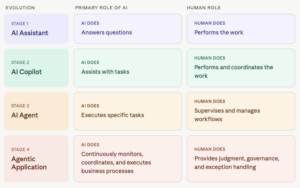
This is an important distinction. A collection of AI assistants can help users complete individual tasks. An agentic application is intended to coordinate an end-to-end process, preserve context across steps, respond when conditions change, and bring people into the process when judgment or approval is required. The potential value is significant, although the quality of the outcome will still depend on organizational readiness.
An Intelligent Talent Profiles Agent can infer skills, although HR leaders will need to understand which data sources contribute to those inferences, how skills are validated, how frequently profiles are updated, and how employees can review or challenge the results. A Manager Coaching Workspace can provide development recommendations, although organizations must decide which information is appropriate to use and ensure that managers understand the difference between an AI-generated recommendation and an accountable management decision. Workforce planning agents can identify gaps, although their conclusions will only be as reliable as the organization’s business assumptions, job architecture, workforce data, and skills taxonomy.
Agentic AI can reduce administrative work and connect information more effectively. It does not eliminate the need for sound talent practices, clear decision rights, data governance, or human accountability.
Competitive Perspective
Oracle is advancing a narrative that will increasingly define competition across the enterprise application market: the suite is evolving from a system of record into a system that helps produce outcomes. (See System of Record with Oracle’s Chris Leone to learn more)
Most major HCM providers are investing in AI agents, skills intelligence, talent marketplaces, learning personalization, and/or workforce planning. The competitive question is moving away from whether a platform offers an AI assistant. The more important questions are:
- Can the AI access a reliable enterprise context?
- Can it connect activities across multiple HR processes?
- Can it take approved actions inside existing workflows?
- Can the organization understand and audit what it did?
- Can customers adapt the agents to their own policies and operating models?
- Can the technology work across HR and other enterprise functions?
Oracle’s broad Fusion Applications footprint across HCM, ERP, Supply Chain, and Customer Experience strengthens its position in this discussion. Workforce decisions are rarely driven by HR data alone. Hiring plans depend on financial forecasts. Skill requirements emerge from changes in products, operations, or supply chains. Organizational design is influenced by cost targets, automation investments, and market demand.
A platform that connects these signals has an opportunity to make talent planning more closely aligned with business strategy and execution.
Oracle is also giving customers and partners the ability to build and extend these systems through AI Agent Studio. In July, Oracle expanded the Studio with a unified no-code, low-code, and professional development experience for creating Fusion Agentic Applications that run inside the Fusion framework. This supports Oracle’s argument that enterprise AI must inherit security, approvals, governance, and auditability from the applications where the work occurs.
The Bigger Picture
Oracle’s latest HCM announcement fits into a larger reinvention of enterprise software.
Traditional enterprise systems were built primarily to store information, enforce processes, and record completed transactions. Generative AI added a conversational layer that could summarize information, generate content, and help users navigate those systems. AI agents added the ability to complete defined tasks. Oracle is now advancing to another stage: coordinated agentic applications that operate against an objective and help move an entire process forward.
In talent management, that progression can be seen clearly. The system begins with an understanding of how work and roles are changing. It identifies the skills available across the workforce. It compares those skills with anticipated demand. It creates or recommends development resources. It guides employees and managers. It supports internal movement. It then measures whether the organization is building the talent supply it will need.
That is a much more connected proposition than simply adding AI to individual HR transactions. It also places HCM in a more strategic position within the enterprise technology landscape. If workforce plans can respond to signals from finance and operations, and if talent actions can be initiated based on those plans, HCM becomes part of the organization’s business execution system.
For HR leaders, this shift creates three priorities.
The first is foundation. Organizations need credible job, skills, learning, and workforce data before they can expect agentic applications to produce reliable results.
The second is governance. HR teams must define where agents can recommend, where they can act, what approvals are required, and when human judgment must control the decision.
The third is operating model readiness. HR functions will need to redesign processes around continuous insight and intervention. Installing agentic capabilities while retaining fragmented ownership and annual talent cycles will limit their value.
HR leaders should therefore evaluate this announcement as a connected operating model for HCM and talent rather than a menu of AI features.
Bottom Line
Oracle’s new Fusion Agentic Applications and AI agents extend its HCM strategy from automating HR tasks toward coordinating talent outcomes. The individual capabilities address practical needs in job design, skills intelligence, learning, coaching, mobility, and workforce planning. Their larger value comes from connecting these activities so that changes in business demand can move more quickly through the talent system.
For Oracle customers, the announcement creates an opportunity to examine where disconnected data, manual coordination, and static talent processes are slowing workforce decisions. It also creates a responsibility to strengthen data foundations, governance, transparency, and human oversight before expanding the role of AI in consequential talent decisions.
For the HR technology market, Oracle is reinforcing an important direction. The next phase of HCM will be defined by systems that help organizations continuously shape and reinvent the workforce.
The central question for HR leaders has advanced from, “What can this AI agent do?” It is now, “What workforce outcome are we trying to achieve, and can our technology, data, policies, and people work together to achieve it?”
Read more about Oracle’s announcement here.

How we can help
Led by Trish Steed and Steve Boese, H3 HR Advisors harnesses over 40 years of experience to delivery HCM insights and guidance to global organizations.
H3 HR Advisory services
By leveraging technology, analytics, and our deep industry knowledge we can help you to reposition your workforce and ensure that you have the right people with the right capabilities in the right roles to positively impact the growth of your business.
HR Happy Hour Podcast Network
Created in 2009, The HR Happy Hour Show is hosted by Steve Boese and Trish Steed and is the longest continuously running internet radio show and podcast on Human Resources, HR Technology, Talent Practices, Workplace and Leadership topics.
H3 HR Speaking Services
We work closely with every client to customize your content - keynotes, webinars, research, infographics, and buyer’s guides - to inspire, educate and inform the audience enabling you to reset and realign your organization for a talent-led breakthrough.
Get in touch
Talk to us today and find out how we can help you and your organization leverage HCM technology to attract, onboard, retain and manage top talent.