
AI Can Influence the HR Decision but it Cannot Assume the Responsibility.
August 17, 2026
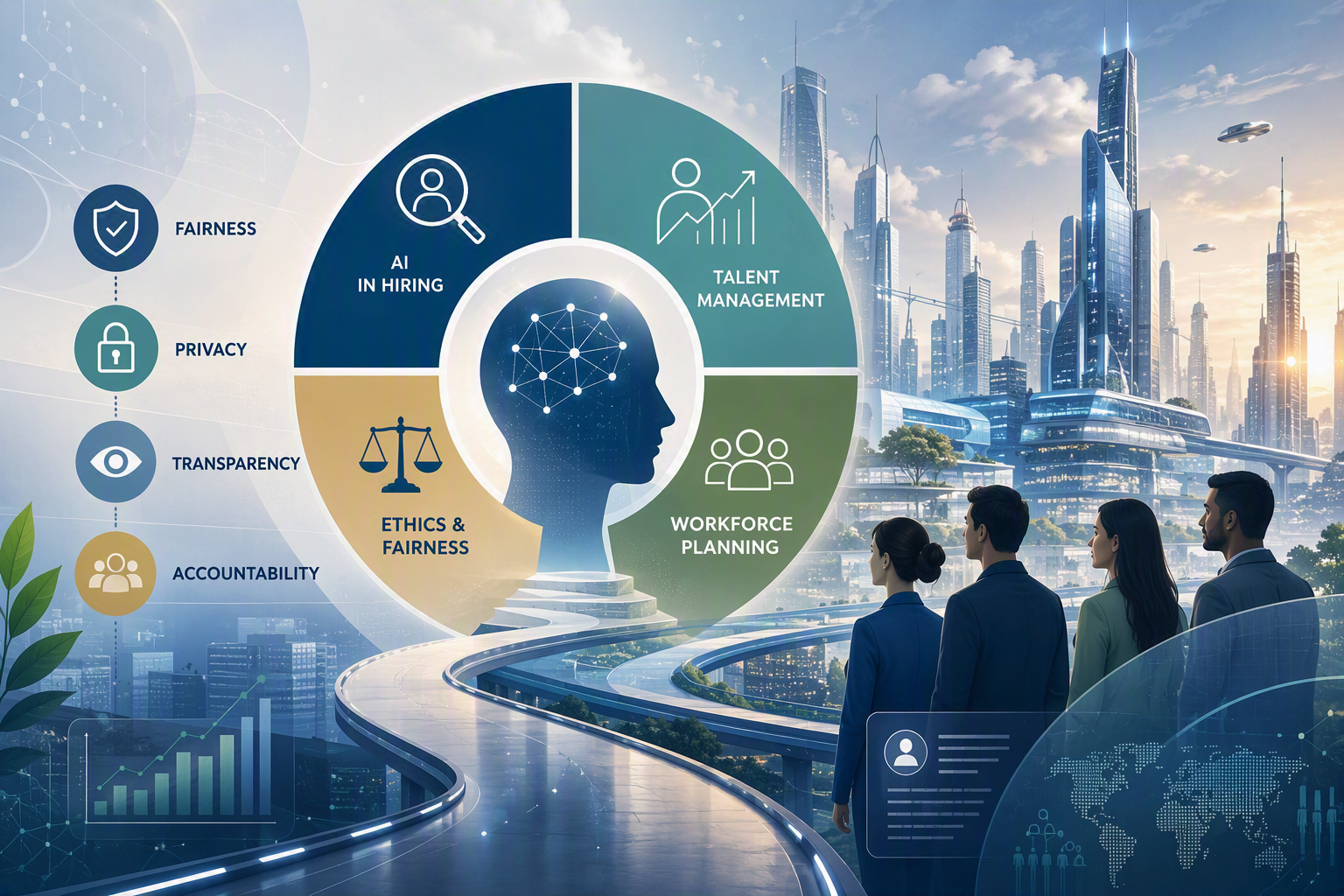
A practical framework for the ethical use of AI in hiring, talent management, and workforce planning
Artificial intelligence is becoming embedded in some of the most consequential decisions organizations make about people.
It can influence who sees a job opening, whose application receives attention, and which candidates advance. Inside the organization, it can help shape performance ratings, compensation decisions, promotions, development opportunities, and succession plans. At the workforce level, AI can identify tasks for automation, redesign jobs, forecast staffing requirements, and inform decisions about how many people an organization believes it will need.
These applications are often discussed separately. Hiring AI is treated as a selection issue. Performance and promotion tools are placed within talent management. Automation and staffing models are considered matters of workforce strategy.
For employees, candidates, and communities, however, these systems form a connected chain of decisions about economic opportunity:
- Who gets an opportunity?
- Who gets ahead?
- Whose work continues to be valued?
That connection gives HR leaders a useful way to approach the ethics of AI. The central issue is larger than whether a particular algorithm is accurate or a vendor has completed a bias audit. It concerns how organizations exercise power when technology influences decisions that can change someone’s career or livelihood.
One principle should carry across the entire employment lifecycle:
AI may assist an employment decision, but it cannot absorb moral responsibility for that decision.
The employer remains responsible for the criteria it chooses, the systems it deploys, the data it uses, the outcomes it produces, and the recourse available to the people affected.
Who gets an opportunity? AI in hiring and selection
AI is already present throughout recruiting. Employers use it to write job descriptions, place advertisements, find potential candidates, screen résumés, match people to openings, administer assessments, summarize interviews, and recommend who should advance.
Some applications are primarily administrative. Scheduling interviews or answering routine questions carries relatively limited risk. Other applications determine who sees an advertisement, whose résumé reaches a recruiter, who passes an assessment threshold, or which recorded interviews appear to demonstrate the desired characteristics. The ethical distinction is the difference between helping manage a process and effectively determining its outcome.
HR leaders should begin by mapping every point at which AI enters the hiring process. Looking only at the final hiring decision misses the earlier moments when candidates can be screened out. A sourcing system may decide who is invited to apply. A matching algorithm may rank applicants before a recruiter reviews them. An assessment may generate a recommendation. Generative AI may summarize all available information and suggest who should move forward.
At each point, the organization should understand what the system measures, what it attempts to predict, how it was validated, and whether its criteria are meaningfully related to success in that particular job. Leaders should ask whether outcomes have been tested across demographic groups, whether people with disabilities can obtain accommodations, and whether candidates can correct inaccurate information or request human review.
It is insufficient to ask whether a product uses AI responsibly.
HR must determine whether the employer is using that product responsibly in its own context. A tool validated for one role may be applied to another. A system designed to recommend candidates may gradually become a rejection mechanism. Recruiters may treat a ranking as more definitive than its designers intended. A feature introduced to improve efficiency can quietly become one of the most powerful decision points in the process.
The common claim that AI will remove human bias also requires scrutiny. AI may reduce certain forms of individual subjectivity, while reproducing patterns embedded in historical data and previous organizational decisions.
If a system learns from the characteristics of people an organization previously hired, promoted, or considered successful, it can learn the organization’s past preferences along with its past inequities. It may favor particular schools, employers, career paths, communication styles, work histories, or patterns of availability. Removing protected characteristics does not eliminate the possibility that other data will act as proxies for them. A system does not need discriminatory intent to create an unfair result.
Responsible use in hiring requires job relevance, validity, reliability, transparency, accessibility, ongoing testing, and a meaningful path to challenge an error. The level of scrutiny should rise with the consequence of the decision. Using AI to suggest interview times presents a very different risk from using it to decide that someone will never receive an interview.
Who gets ahead? AI in performance, pay, and advancement
Once someone joins an organization, AI may continue to shape their opportunities.
Employers can use it to synthesize feedback, analyze goals, recommend performance ratings, identify skills, suggest compensation increases, flag pay disparities, predict attrition, recommend internal opportunities, designate high-potential employees, and identify successors for leadership roles. These capabilities can reveal overlooked talent, improve consistency, and help managers process information. They also introduce a fundamental problem: AI tends to give the greatest weight to what an organization can capture, quantify, and compare.
Human performance includes contributions that leave a limited digital trail. Who supports a struggling colleague? Who prevents problems before they occur? Who improves the judgment of the team, develops others, builds trust, protects a customer relationship, or accepts essential work that receives little recognition? At the same time, an employee who sends more messages, attends more meetings, generates more system activity, or works more visible hours may appear highly productive to an algorithm.
Activity can be measured. Value requires interpretation.
The ethical danger appears when organizations allow what is measurable to become their definition of what matters. Context matters just as much. Performance data may reflect the quality of assignments an employee received, the condition of an inherited territory, the resources available, the support of a manager, or the visibility of a role. One person may have received stretch assignments, mentoring, and executive exposure. Another may never have been invited into those opportunities.
An AI system can identify differences in their results. It may have no meaningful way to understand the differences in their circumstances.
This becomes especially important in promotion and succession. A system asked to identify future leaders may look for people who resemble those who succeeded previously. If past leaders followed similar career paths or reflected a narrow leadership profile, the system may reproduce that pattern under the appearance of objective analysis. A prediction based on the past can quietly become a mechanism for preserving the past.
Compensation presents related questions. AI can identify unexplained pay differences and support consistent decision-making. It can also recommend pay based on performance scores, previous salary information, market data, retention risk, or an employee’s predicted willingness to leave. Should two employees delivering comparable value receive different pay because an algorithm predicts that one is more likely to resign? A recommendation may appear economically rational while contributing to an inequitable result. Prediction accuracy, efficiency, and fairness are distinct objectives.
Employees also need the ability to understand and challenge consequential decisions. If someone is denied a promotion, excluded from a succession plan, assigned a lower rating, or offered a smaller increase, the manager should be able to explain the decision in understandable terms. The employee should be able to correct inaccurate information and receive a meaningful review.
“The algorithm did not identify you” cannot become an acceptable explanation for a career-changing decision.
Whose work continues to be valued? AI in workforce planning
The third set of decisions moves beyond individual employees to the design of the workforce itself.
Organizations are using AI to forecast staffing requirements, identify skill gaps, analyze workloads, redesign jobs, automate tasks, and model different combinations of employees, contractors, technology, and AI agents. These capabilities can help employers address labor shortages, remove repetitive work, improve safety, and give people more time for judgment, creativity, relationships, and problem-solving.
The ethical challenge arises when organizations move from asking how AI can improve work to asking how many people AI can replace.
That framing oversimplifies how work is performed. A job is rarely one task. Most jobs combine activities, decisions, responsibilities, interactions, and relationships. AI may perform some tasks extremely well, assist with others, and remain poorly suited to several of the most important ones.
If AI can automate 30 percent of the tasks in a role, it does not automatically follow that the organization needs 30 percent fewer people in that role. The additional capacity could improve service, reduce burnout, reach more customers, create new products, or address work that has been repeatedly postponed.
Headcount reduction is one possible choice. It is not the inevitable conclusion produced by AI technology.
The central question is what the organization chooses to optimize. A workforce model can optimize labor cost, operating margin, speed, service quality, innovation, resilience, workload, or customer experience. Different objectives will produce different recommendations. If leaders ask for the lowest-cost workforce configuration, the system may recommend fewer people, more automation, greater work intensity, and less organizational capacity. The recommendation may be mathematically consistent with its objective. That does not make the objective responsible or complete.
A model cannot decide how much an organization should value employment stability, worker development, institutional knowledge, customer relationships, or resilience. It cannot determine who deserves the benefits of higher productivity or who should carry the disruption. Leaders make those choices.
This is why organizations should be cautious about describing workforce reductions as decisions made by AI. Technology may identify automatable tasks, calculate savings, and model staffing scenarios. It does not decide whether employees receive training, reassignment, severance, or time to transition. It does not choose between investing in an existing workforce and replacing people in pursuit of a faster financial return.
Workers understand this tension. Employers want employees to experiment with AI, document their processes, share what they learn, and identify opportunities for automation. Employees may reasonably wonder whether helping the organization understand their work will eventually help eliminate their jobs.
Responsible adoption requires a credible answer to the question employees are already asking: What happens to me if this technology works?
Human oversight must involve human judgment
Across hiring, talent management, and workforce planning, organizations frequently point to “human oversight” or “humans in the loop” as the primary safeguard. The phrase can create more confidence than the underlying process deserves.
Placing a person somewhere in a workflow is insufficient. A recruiter who automatically follows a candidate ranking, a manager who accepts an AI-generated performance rating, or an executive who treats a workforce forecast as inevitable is providing approval rather than judgment.
Meaningful oversight requires a person who:
- Understands what the system is designed to do.
- Knows which information influences its recommendation.
- Recognizes the system’s limitations and missing context.
- Has the authority to reach a different conclusion.
- Can explain the decision to the person affected.
- Remains accountable for the outcome.
AI can identify patterns and produce recommendations. Human leaders must determine what those patterns mean, whether the recommendation is legitimate, and what consequences the organization is willing to accept.
A practical framework for responsible AI decisions
HR leaders can apply the same five-part framework whenever AI affects a consequential employment decision.
1. Identify where AI enters the decision
Map the entire process, including AI capabilities embedded inside existing platforms. Determine where the technology provides administrative assistance, where it influences judgment, and where it can effectively determine an outcome.
2. Understand what the system measures
Examine the data, assumptions, intended use, validation, limitations, and affected populations. Ask whether the system is measuring something meaningfully connected to the decision or merely using an available proxy.
3. Determine who carries the risk
Identify who receives the benefit when the system works and who experiences the consequences when it fails. When organizations receive most of the efficiency gains while workers or candidates bear most of the risk, the employer assumes a greater responsibility for testing, transparency, and remedy.
4. Establish the ethical and legitimate boundaries
Evaluate job relevance, fairness, transparency, privacy, explainability, accessibility, human accountability, and recourse. Define which uses AI may support, which require elevated review, and which decisions the organization will never delegate to an algorithm.
5. Monitor outcomes and provide recourse
Governance cannot end when a tool is purchased or deployed. Monitor who is selected, rewarded, promoted, developed, retained, reassigned, and displaced. Give affected people a practical way to correct inaccurate information, request an explanation, and obtain meaningful human review.
The future remains a human choice
AI can help employers discover candidates who traditional processes overlook. It can reveal skills, improve internal mobility, identify inequities, remove repetitive work, and give leaders better information about the future. It can also scale past biases, create false precision around deeply human judgments, turn workplace activity into a substitute for value, and give leaders a technical-sounding justification for decisions they already wanted to make. The difference will not be determined by the sophistication of the model alone. It will be shaped by the values, incentives, governance, and judgment surrounding its use. Who gets an opportunity? Who gets ahead? Whose work continues to be valued?
AI will increasingly influence the answers. Responsibility for those answers remains human.
Catch our three-part series on Ethics, AI, and HR on The Workplace Minute here.
How we can help
Led by Trish Steed and Steve Boese, H3 HR Advisors harnesses over 40 years of experience to delivery HCM insights and guidance to global organizations.
H3 HR Advisory services
By leveraging technology, analytics, and our deep industry knowledge we can help you to reposition your workforce and ensure that you have the right people with the right capabilities in the right roles to positively impact the growth of your business.
HR Happy Hour Podcast Network
Created in 2009, The HR Happy Hour Show is hosted by Steve Boese and Trish Steed and is the longest continuously running internet radio show and podcast on Human Resources, HR Technology, Talent Practices, Workplace and Leadership topics.
H3 HR Speaking Services
We work closely with every client to customize your content - keynotes, webinars, research, infographics, and buyer’s guides - to inspire, educate and inform the audience enabling you to reset and realign your organization for a talent-led breakthrough.
Get in touch
Talk to us today and find out how we can help you and your organization leverage HCM technology to attract, onboard, retain and manage top talent.