
ADP’s AI Opportunity: Turning Workforce Scale into Workforce Intelligence
September 23, 2026
ADP is turning its scale, workforce data, payroll expertise, and deep operational context into the foundation for a new generation of AI-powered systems that increasingly move from providing information to executing work.
There is a familiar pattern to enterprise technology events in 2026. AI dominates the agenda. Product demonstrations feature assistants and agents. Roadmaps promise increasing levels of automation. And almost every provider wants customers and analysts to understand that AI is no longer simply an add-on to its applications but is now a core capability of the platform itself.
ADP’s recent Innovation Update certainly contained many of those elements. But after reviewing the company’s strategy, product demonstrations, development roadmap, and early customer results, we came away thinking the more important ADP story is not about any particular AI feature or agent.
It is about the foundation upon which these new AI tools are built.
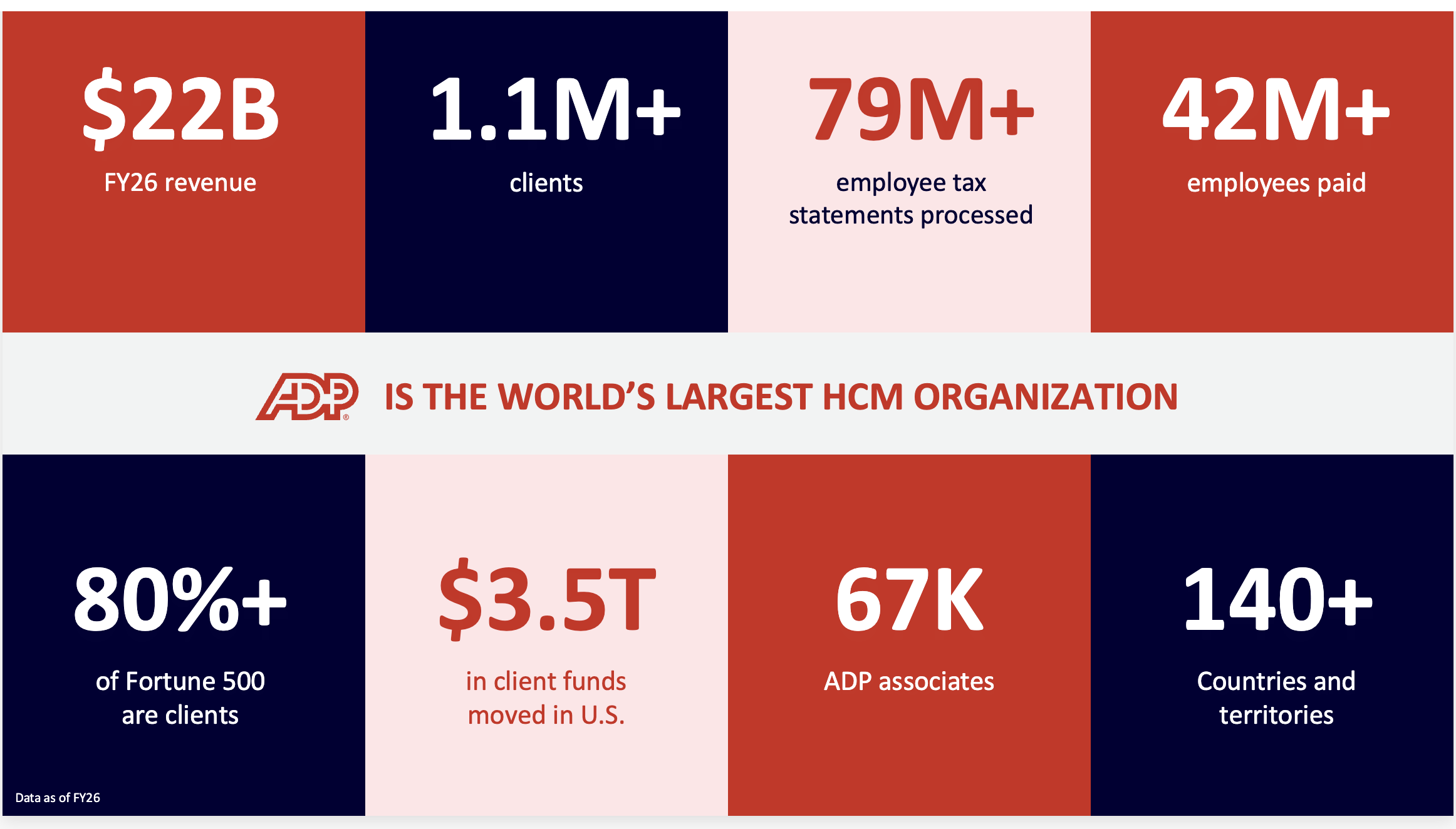
ADP enters this next era of enterprise technology with a distinct collection of assets: enormous workforce scale, decades of payroll and HR process experience, extensive workforce and employment data, compliance expertise, established business rules and workflows, and the security and permissions necessary to execute consequential workforce transactions. ADP reports more than 1.1 million clients, more than 42 million employees paid, $3.5 trillion in U.S. client funds moved, and relationships with more than 80% of the Fortune 500.
Scale alone does not make an AI strategy successful. Nor does possessing enormous amounts of data guarantee better AI. But as enterprise AI transitions from just answering questions toward performing work, those existing assets become more important and potentially market defining.
That was the signal from ADP Innovation Day that interested us most.
From AI That Answers to AI That Acts
For the last several years, expressions of enterprise AI have focused on helping users find information, summarize content, generate text, identify patterns, and make recommendations. Those capabilities remain valuable, but the HCM market is clearly moving into another phase.
AI is beginning to perform and execute actions.
ADP described its own evolution through a useful framework: Assist, Own, Orchestrate. Initially, AI assists people in performing individual tasks. The next stage introduces what ADP calls role-based “digital employees” capable of taking greater responsibility for functions and outcomes. Eventually, multiple agents can orchestrate work across roles, processes, and applications.
We are seeing the same signal throughout enterprise technology. Providers like Oracle, ServiceNow, Salesforce, and more are describing a world where the traditional system of record evolves into a system of action or execution. Instead of requiring a person to navigate an application, find information, interpret it, decide what needs to happen, and then execute a series of transactions, AI increasingly sits between the person and the underlying enterprise systems and performs more of that work. ADP’s development roadmap reflects this transition.
In Workforce Now, ADP says it already has more than 50 agentic activities across the HR and talent journey and more than 100 across the payroll cycle. These include job changes, payroll corrections, payroll variance analysis, reporting, recruiting activities, performance processes, learning recommendations, employee pay explanations, and numerous other tasks.
The Lyric HCM roadmap goes further, extending agentic capabilities across recruiting, onboarding, global mobility, benefits, performance, learning, payroll, workforce management, tax, and termination processes.
There is an important distinction to make here. A roadmap containing many agents is not the same thing as a fully agentic HCM platform. Much of the industry’s larger vision for cross-functional orchestration and true systems of execution remains ahead of us, including at ADP.
But the direction is unmistakable. The HCM platform is evolving from a place where people go to perform work toward an underlying infrastructure through which AI can understand, coordinate, and eventually execute work.
ADP’s Most Interesting AI Advantage
This leads to what we believe was the most important takeaway from the event.
ADP’s most interesting AI advantage is not just its AI tools. Tools are quicky copied in the HCM market. But ADP has an advantage not so easily copied – its massive scale. It is everything ADP already knows about how people, payroll, compliance, and work actually operate.
The distinction becomes further illustrated as the underlying AI models become more capable and more widely available.
Most major HCM providers have access to sophisticated foundation models. Most can create conversational interfaces. Most can build agents. The competitive question therefore shifts from Who has AI? to What does your AI know, what context does it possess, and what is it authorized to do?
ADP described part of its advantage as the combination of “money, people, events,” connecting payroll transactions and employment events with organizational structures and other workforce contexts.
Consider what is required for an AI agent to execute a seemingly straightforward employee job change.
It may need to understand the employee, position, organizational structure, compensation, location, payroll configuration, tax implications, benefits implications, approval requirements, company policies, security permissions, and applicable regulations. It may need to coordinate actions across several systems and know when the transaction is unusual enough to require human intervention.
That is fundamentally different from AI generating an answer to an HR policy question.
This is where legacy enterprise platforms may possess an advantage that has sometimes been underestimated in discussions about AI disruption. Their value stems partly from their wealth of historical worker data. They also contain years or decades of accumulated workflows, business rules, permissions, configurations, integrations, compliance logic, transaction histories, and organizational context.
The opportunity is to make historical data and institutional infrastructure accessible to AI. ADP clearly understands this. Its AI architecture emphasizes not only data and models, but knowledge, process intelligence, permissions, governance, explainability, interoperability, and an agent-management layer.
But having these data and context advantages does not guarantee success with AI. Legacy complexity can just as easily become an obstacle to innovation if providers cannot unify and exploit these assets. But ADP possesses substantial raw material from which to build.
And its particular depth in payroll gives it something even more valuable: experience operating processes where accuracy, compliance, security, and trust are non-negotiable.
Workforce Now Provides Scale; Lyric HCM Represents Enterprise Ambition
The two product stories shared during the event were also meaningfully different.
Workforce Now gives ADP an enormous installed environment in which to deploy, test, and refine AI capabilities. ADP cited 25 million employees in the Workforce Now ecosystem.
ADP reported 6.9 million ADP Assist conversations across 104,860 unique clients during the referenced twelve-month period. Its payroll variance functionality was being used by 60% of clients in the analysis ADP presented, with users reporting approximately 30 minutes of average time savings for each variance resolved.
Other early results presented included complex payroll reporting reduced from 30 to 40 minutes to approximately five minutes, and payroll corrections reduced from more than ten manual steps to two actions.
These are largely ADP’s own analyses, pilots, and reported customer results, so they should be interpreted accordingly. But they provide something the HR technology market needs, evidence about actual AI usage and workflow impact rather than simply announcements about availability.
Lyric HCM represents a different challenge and opportunity for ADP.
ADP is positioning Lyric as a global enterprise platform bringing HR, payroll, workforce management, talent, analytics, and service operations into a more unified environment. The company reported steady growth in both the total number of clients and the number of countries with active employees in the last three years.
Lyric appears to be gaining traction, but its development into a scaled global-enterprise HCM competitor is something the market should continue to evaluate rather than something that is complete or assured.
Still, ADP’s global experience creates an interesting foundation. The company has spent decades confronting precisely the kinds of complexities that become difficult when enterprise AI moves from recommendation to execution: country-specific requirements, payroll rules, compliance obligations, different worker types, complex organizational structures, and high-consequence transactions. Global complexity, and its understanding, may become another source of AI context.
What Happens When ADP Is No Longer the Interface?
One of the less obvious elements of the event may ultimately prove to be among the most consequential.
ADP described Model Context Protocol, or MCP, as part of its distribution strategy, with the goal of making ADP intelligence available beyond ADP’s native applications. The company showed a strategy that includes ADP Assist as its native experience while also extending ADP capabilities into external AI environments.
This reflects another signal we are watching closely across enterprise technology.
For decades, enterprise software companies have competed heavily on the application interface and user experience (UX). Users logged into Salesforce, Oracle, SAP, Workday, ADP, or another platform and navigated that vendor’s UX to get work done.
AI will most likely alter that relationship.
Increasingly, the user’s primary interface may be an AI assistant or agent that sits above multiple enterprise systems. The employee or manager may not care about which underlying application stores a particular piece of information. They simply ask for an outcome, and the AI determines which systems, data, and actions are required to produce it. In that environment, the strategic value of an enterprise platform does not disappear. It changes.
The underlying platform still provides authoritative data, transaction history, business rules, security, governance, permissions, workflow logic, and the ability to execute actions safely. In some respects, those capabilities could become more important when fewer people interact directly with the application itself.
ADP’s willingness to contemplate this future is noteworthy. The strategic question shifts from whether ADP owns every screen an employee sees and becomes about whether ADP remains a trusted workforce intelligence, governance, security, and execution layer underneath whatever interface that employee chooses to use. That is a very different way of thinking about the future of HCM.
The Next Test Is Execution
ADP’s Innovation Update demonstrated a company with a much more ambitious AI strategy than simply adding generative features to an established HCM portfolio. There are also plenty of questions, ADP, and other established HCM providers still to answer.
How quickly can individual agents evolve into genuine cross-domain orchestration? How open will ADP’s agent ecosystem ultimately become? And perhaps most importantly, can ADP consistently demonstrate that these capabilities improve business and workforce outcomes rather than simply automate individual transactions? Those questions will matter over the next several years.
But ADP has something worth watching closely. The company possesses extraordinary scale, deep payroll and compliance expertise, extensive workforce context, a large installed customer base, global operating experience, and decades of accumulated process knowledge. It is now attempting to convert those assets into an intelligence and execution layer for the next generation of HCM.
The broader lesson extends well beyond ADP.
As AI capabilities become more powerful and more ubiquitous, the value of enterprise technology may increasingly reside not in the AI model itself, but in the context surrounding it and the trusted actions it is capable of taking.
Increasingly, the question will be: What insight and value does your platform uniquely provide, and what meaningful work can AI safely execute because of it?
Thanks to ADP for inviting us to their Innovation Day event.
Author
Categories
Tags
Share

How we can help
Led by Trish Steed and Steve Boese, H3 HR Advisors harnesses over 40 years of experience to delivery HCM insights and guidance to global organizations.
H3 HR Advisory services
By leveraging technology, analytics, and our deep industry knowledge we can help you to reposition your workforce and ensure that you have the right people with the right capabilities in the right roles to positively impact the growth of your business.
HR Happy Hour Podcast Network
Created in 2009, The HR Happy Hour Show is hosted by Steve Boese and Trish Steed and is the longest continuously running internet radio show and podcast on Human Resources, HR Technology, Talent Practices, Workplace and Leadership topics.
H3 HR Speaking Services
We work closely with every client to customize your content - keynotes, webinars, research, infographics, and buyer’s guides - to inspire, educate and inform the audience enabling you to reset and realign your organization for a talent-led breakthrough.
Get in touch
Talk to us today and find out how we can help you and your organization leverage HCM technology to attract, onboard, retain and manage top talent.