
Solution Review: Indeed Sourcing Assistant – How AI Is Redefining Talent Acquisition
September 15, 2026
For most of its history, recruiting technology has focused on helping employers attract applicants: post a job, generate applications, review resumes, schedule interviews, and ultimately make a hire. That model has served employers well for decades, particularly during periods when talent was abundant, and recruiting was largely a matter of efficiently processing incoming candidates.
Today’s labor market looks very different.
Across many industries, employers continue to face shortages of qualified talent, increased competition for specialized skills, changing candidate expectations, and recruiting teams expected to deliver better outcomes without proportional increases in resources. At the same time, artificial intelligence is changing what software can accomplish. Rather than simply helping recruiters organize work, AI increasingly has the potential to perform meaningful portions of that work alongside them.
Against this backdrop, Indeed’s introduction of Sourcing Assistant, the newest capability within Indeed Smart Sourcing, represents more than another AI feature. It signals another step in the company’s evolution from the world’s largest employment marketplace into a broader AI-powered talent acquisition platform built to help employers identify, engage, and hire talent more effectively.
The Recruiting Challenge Has Changed
One of the defining characteristics of today’s hiring environment is that attracting applicants is often only one part of the challenge, and for a growing share of roles, it isn’t the hard part at all.
Consider two requisitions open at the same time inside the same organization. A customer service role posted on Monday has 800 applications by Friday. Down the hall, an ICU nursing post has been open for 90 days with four applicants, none of whom are qualified. A skilled-trades employer trying to fill a licensed electrician position faces the same imbalance. The volume problem and the quality problem are both real, and they often coexist inside a single recruiting team’s requisition load. Specialized positions, technical occupations, healthcare roles, skilled trades, and many frontline positions frequently require recruiters to actively search for talent rather than simply wait for applicants to arrive.
Many organizations still receive large volumes of applications for some roles while struggling to identify qualified candidates for others. Specialized positions, technical occupations, healthcare roles, skilled trades, and many frontline positions frequently require recruiters to actively search for talent rather than simply wait for applicants to arrive.
Meanwhile, recruiting organizations face their own pressures. Many talent acquisition teams have become leaner over the past several years, yet expectations around hiring speed, candidate experience, quality of hire, and strategic workforce planning continue to increase. Recruiters are increasingly expected to serve as talent advisors to the business while simultaneously managing larger requisition loads and more complex hiring environments.
These realities are changing the role of recruiting technology. The next generation of platforms must do more than help recruiters manage information. They must help recruiters accomplish work more efficiently and surface opportunities that might otherwise remain hidden.
What Sourcing Assistant Does
Sourcing Assistant is built around a simple premise: instead of recruiters manually building Boolean strings and paging through resume search results, they simply describe who they need in natural language, calibrate the Assistant to ensure it’s captured the role criteria and the system takes on the discovery work from there. This calibration or training of the Assistant helps show that what the Assistant will source mirrors the criteria correctly. The recruiter can always go back and fine tune their criteria, based on the calibration.
In practice, that means recruiters can assign up to three open jobs to Sourcing Assistant at a time and let it run continuously, identifying right-fit candidates based on skills, activity, and profile signals rather than keyword matches alone. The Assistant can also handle early-stage engagement, drafting AI-generated outreach based on a candidate’s resume or a recruiter’s own proven templates, with limits recruiters set themselves to control pacing and pipeline volume. That last point matters: this is discovery and outreach running around the clock with recruiter-defined guardrails, not a fully autonomous system operating without oversight.
Completed applications flow directly into the recruiter’s existing workflow, and where Indeed Apply sync is enabled, straight into the employer’s ATS, so sourced candidates don’t require a separate manual hand-off. It’s also worth noting Sourcing Assistant is one part of the broader Smart Sourcing suite, which pairs it with traditional resume search and filtering, so recruiters can move between manual, hands-on search and automated, always-on discovery depending on the role.
This is a meaningful shift from how sourcing has traditionally worked. Recruiters have long had to construct searches, review large numbers of profiles, refine criteria, and judge which candidates warrant outreach, with success often depending as much on recruiter experience as on the technology itself. Sourcing Assistant doesn’t remove that judgment from the process; it moves recruiters from executing every search themselves to reviewing and directing a pipeline that’s already being built. The objective is to amplify the expertise of the recruiters, not to replace them.
The Numbers Behind the Story
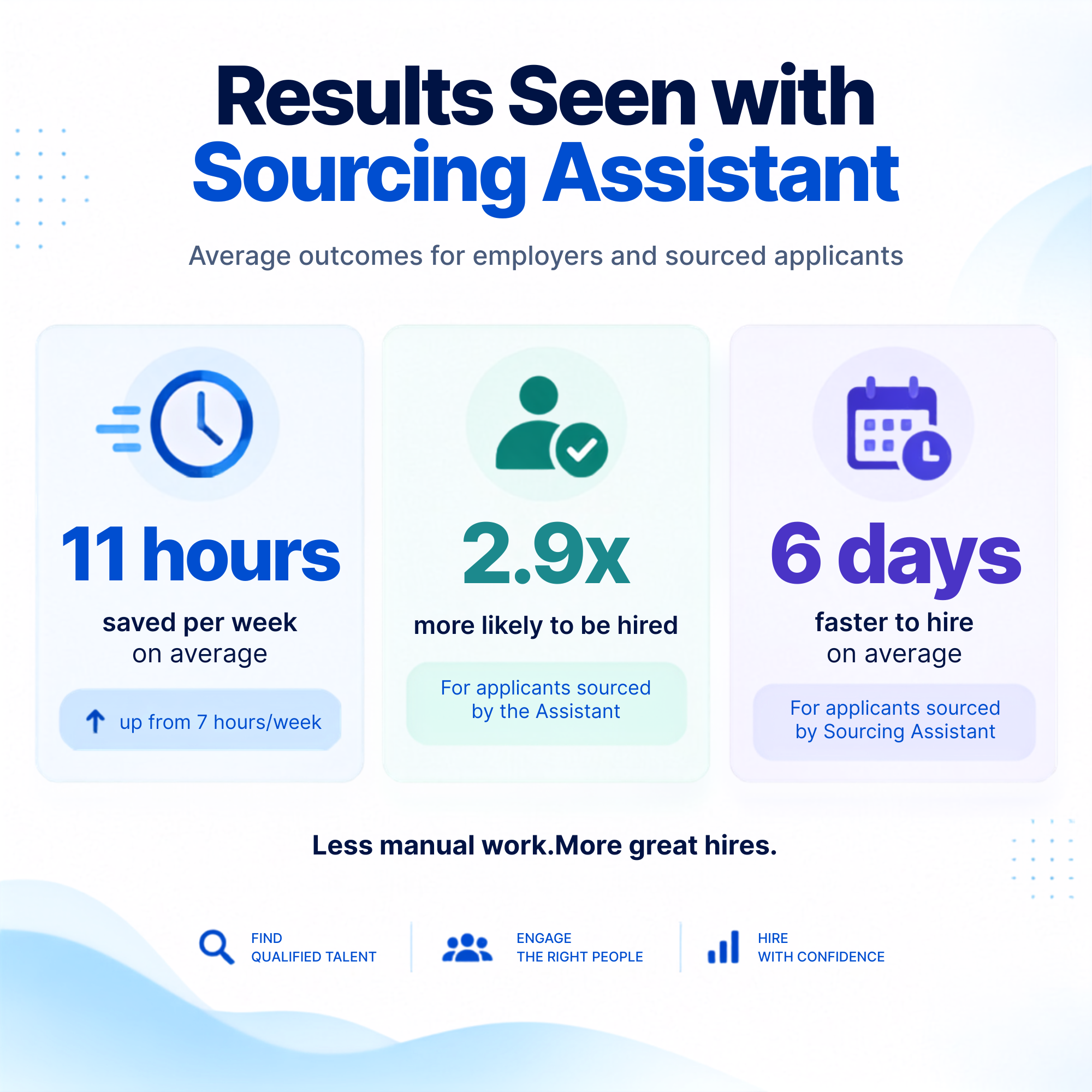
Vendor-reported statistics deserve scrutiny, but the numbers Indeed has published around Sourcing Assistant are specific, and they point to the same conclusion from three different angles: better matches, faster hires, and measurable time returned to recruiters. 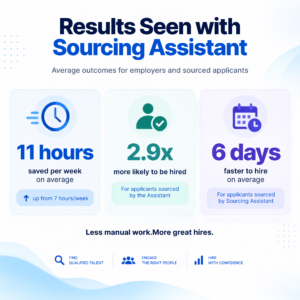
Taken together, these figures reframe what quality of hire and time-to-hire mean in an AI-sourcing context, and they give recruiting leaders a concrete basis for building a business case rather than relying on a general sense that AI should help.
I trusted (Sourcing Assistant) from day one…because the therapists engaging from those messages are clearly the right clinical profiles and the message is resonating.
— Yale Smith, Stern at Home Therapy
Why Indeed is Well Positioned
Sourcing Assistant also builds on capabilities Indeed has developed over many years and reflects a broader shift occurring across the HR technology market: talent acquisition platforms expanding beyond applicant tracking and job advertising into systems that actively manage and participate in recruiting workflows.
Few organizations possess the breadth of labor market activity, employer engagement, job seeker participation, and hiring interactions that Indeed has accumulated through operating one of the world’s largest employment marketplaces. That scale provides unique insight into hiring demand, candidate behavior, occupational trends, and workforce movement across industries and geographies. As AI becomes increasingly dependent upon high-quality data and rich context, those underlying assets become strategic advantages.
Rather than introducing AI as an isolated capability, Indeed is applying intelligence across an ecosystem built around employers, job seekers, jobs, skills, and hiring activity. The value comes not only from the AI itself, but from the quality and scale of the information that informs its recommendations. That combination positions Indeed to help employers move beyond simply generating applicant volume toward identifying stronger candidate matches and improving overall recruiting efficiency. And it mirrors a broader pattern across enterprise software, where AI is moving from assisting users to completing meaningful work on their behalf.
What HR Leaders Should Take Away
For HR and talent acquisition leaders, the larger lesson extends well beyond any individual product announcement.
The future of recruiting will likely depend less on how effectively organizations manage applicants and more on how effectively they identify, engage, and build relationships with talent before traditional application processes even begin. That shift places greater importance on recruiter productivity, intelligent automation, skills-based matching, and technologies capable of helping recruiters spend more time exercising judgment rather than performing repetitive administrative work.
It also reinforces the growing importance of selecting technology partners that combine AI capabilities with deep labor market expertise and comprehensive data. As AI becomes embedded throughout recruiting workflows, the quality of the underlying data may become just as important as the sophistication of the models themselves, and the guardrails employers can set around automation, such as job limits, outreach protocols, and ATS sync, may matter just as much as the AI’s raw capabilities.
The Bottom Line
Indeed Sourcing Assistant should be viewed as more than another AI feature added to a recruiting platform. Backed by measurable outcomes and built on top of one of the largest labor market datasets in the world, it represents a genuine milestone in how sourcing gets done, not just another automation layer on an old process.
As employers continue navigating talent shortages, evolving workforce expectations, and increasing pressure to improve hiring outcomes, technologies that help recruiters find qualified candidates faster, reduce manual effort, and focus on higher-value activities will only become more important.
The organizations that gain the greatest advantage from AI will not simply automate existing recruiting processes. They will rethink how recruiting work gets done, enabling their talent acquisition teams to become more strategic, more proactive, and ultimately more effective. Indeed’s continued investment in AI-powered sourcing suggests that this transformation is already well underway.
Learn more about Indeed Sourcing Assistant here.
And watch a replay of my H3 LIVE conversation about Sourcing Assistant with Thomas Bergman from Indeed here.
Author
Categories
Tags
Share

How we can help
Led by Trish Steed and Steve Boese, H3 HR Advisors harnesses over 40 years of experience to delivery HCM insights and guidance to global organizations.
H3 HR Advisory services
By leveraging technology, analytics, and our deep industry knowledge we can help you to reposition your workforce and ensure that you have the right people with the right capabilities in the right roles to positively impact the growth of your business.
HR Happy Hour Podcast Network
Created in 2009, The HR Happy Hour Show is hosted by Steve Boese and Trish Steed and is the longest continuously running internet radio show and podcast on Human Resources, HR Technology, Talent Practices, Workplace and Leadership topics.
H3 HR Speaking Services
We work closely with every client to customize your content - keynotes, webinars, research, infographics, and buyer’s guides - to inspire, educate and inform the audience enabling you to reset and realign your organization for a talent-led breakthrough.
Get in touch
Talk to us today and find out how we can help you and your organization leverage HCM technology to attract, onboard, retain and manage top talent.