
From Systems of Record to Systems of Outcomes: The Next Shift in HR Technology
May 6, 2026
Excellence in enterprise software has often been defined by better apps and fancier user interfaces. We see that changing. Soon, excellence will be shaped by the systems that can execute work and drive outcomes. Here’s what that shift means and why it matters to HR leaders now.
For decades, enterprise software has been built around a simple idea: applications are where work happens. Employees log in, navigate workflows, complete transactions, and move processes forward step by step. In HR technology, this has meant systems of record like payroll platforms, HRIS, recruiting systems, and learning platforms, that each were designed to capture data, enforce process, and ensure compliance.
That model has served organizations well. It created structure, consistency, and scale. It allowed companies to manage increasingly complex workforces with confidence. But it also placed most of the burden on people. Humans had to interpret information, decide what to do next, navigate lengthy menus and decision trees, and manually push work forward inside the system.
Over the past two years, generative AI has begun to change that dynamic. Copilots and assistants have made it easier to write, summarize, analyze, and communicate. They have improved productivity and reduced friction in everyday work. Many organizations are still in the early stages of realizing the value of these tools.
But something more significant is now emerging.
The next phase in enterprise software is about more than just helping people do work more efficiently. It promises systems that can actually execute work. This is the shift from systems of record to what can be described as systems of outcomes.
How We Got Here
To understand why this shift matters, it helps to look at how enterprise software has evolved.
The first major phase was the system of record era. These systems captured transactions, stored data, managed simple workflows, and enforced policy. Their value came from accuracy, reliability, and control. They became the backbone of HR operations, finance, supply chain, and beyond.
The next phase focused on user experience. Vendors invested heavily in better interfaces, mobile access, and employee-centric design. Work became easier to navigate, but the fundamental model did not change. People still had to drive the process, only it could now be managed more flexibly.
Then came the rapid introduction and rise of Generative AI. Often expressed in the form of Copilots and Assistants, GenAI brought a new level of capability. Employees could generate content, summarize information, and get quick answers without digging through complex and sometimes unfamiliar systems. This was a meaningful step forward, and it continues to deliver real value.
At the same time, copilots largely operate within the same basic, traditional structures. They support the user. But they do not redefine the system.
That is where the next shift begins.
From Assistance to Execution
A helpful way to think about the current moment is to separate three layers of AI that are often discussed together.
Generative AI focuses on creating content and answering questions. Workflow AI focuses on automating repeatable processes and reducing manual effort. Agentic AI introduces a different concept. It is designed to work toward outcomes.
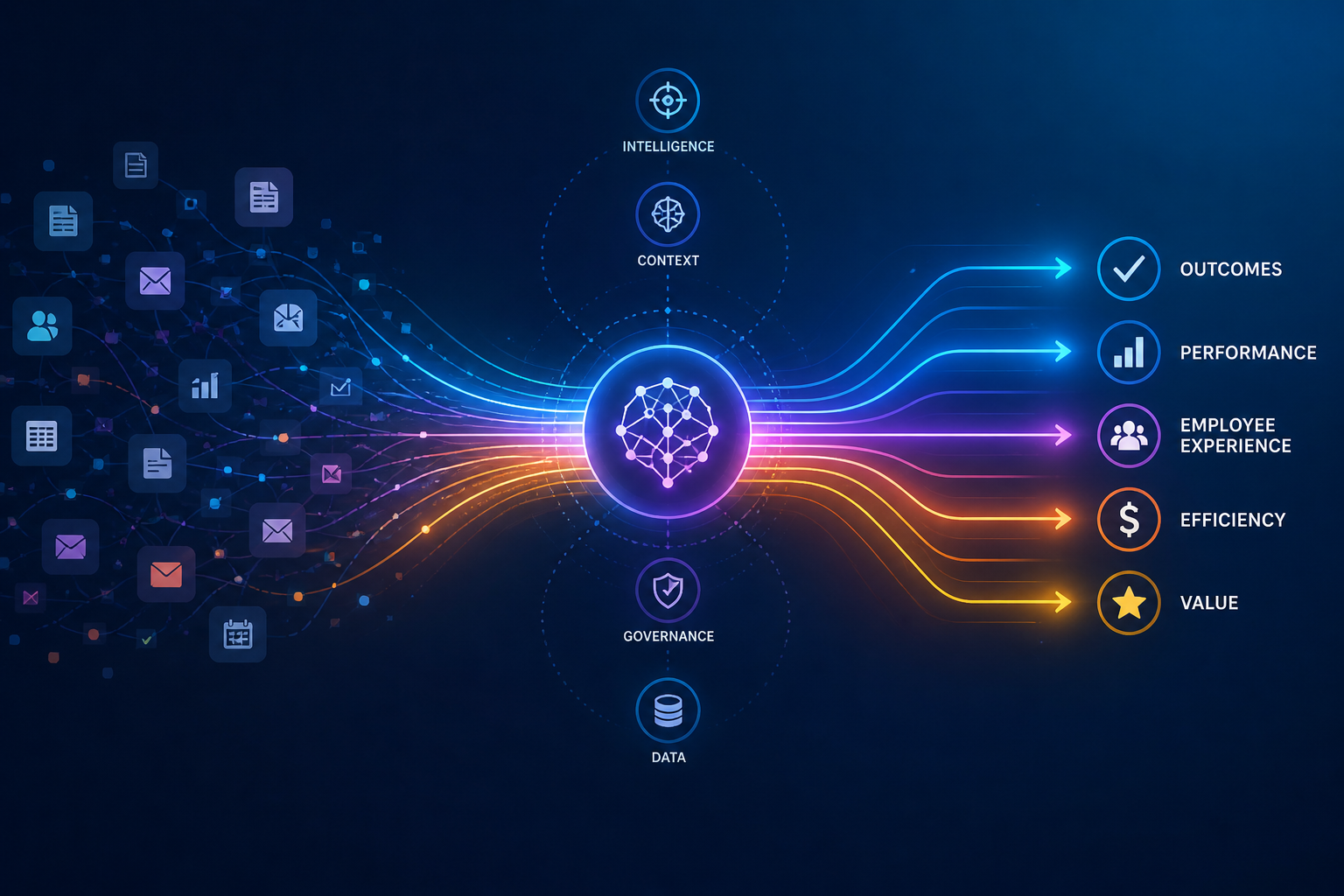
An agentic system does not wait for instructions in the same way a copilot does. It monitors activity, interprets context, recommends actions, and can carry out those actions within defined guardrails. The goal is not to assist with a task. The goal is to achieve the desired result.
This changes the role of the application. Instead of serving as a place where tasks are completed, the system becomes an active participant in moving work forward.
Oracle and the Emergence of Systems of Outcomes
One of the clearest signals of this shift came recently from Oracle during an industry analyst session led by Chris Leone. The framing was clear: enterprise applications are evolving from systems that record what happened to systems that help determine what should happen next and then execute against that objective.
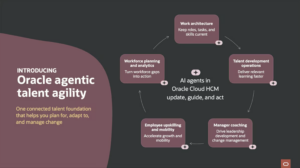
Oracle’s approach centers on what it calls agentic applications. These applications are built around defined outcomes rather than managing individual transactions. Instead of a user navigating screens and workflows, the system assembles teams of specialized AI agents that collaborate around a specific goal or outcome.
Those agents bring context, domain expertise, and memory. They analyze data across the system, identify priorities, recommend next steps, and in many cases initiate actions. A human remains involved, especially in oversight and decision-making, but the system takes on a much larger role in advancing the work itself.
This is a meaningful departure from the traditional enterprise technology model. The application is no longer a passive environment. It becomes an execution layer.
What makes this approach particularly significant is where it sits. These capabilities are built directly on top of the system of record. That means they inherit the permissions, security controls, auditability, and transactional integrity that organizations already rely on. This foundation is essential if systems are going to take on more responsibility in executing work.
Oracle’s strategy reflects a broader realization across the market. The value of AI in enterprise software is not limited to insights or recommendations. The real value comes from the ability to take action.
A Practical Signal for the SMB Market from Paycom
While Oracle’s vision is expansive, there are also more focused examples that point in the same direction. Paycom provides a useful case.
When Paycom introduced its iWant capability in 2025, including Executive Mode, the emphasis was on natural language interaction with system data. Leaders could ask questions, explore information, and initiate actions without navigating traditional interfaces.
At first glance, this appears to be an interface improvement. It simplifies access and makes the system easier to use. The deeper implication is more interesting. The interaction model begins to shift from navigating workflows to directing outcomes.
When a leader can ask the system to analyze a workforce issue, surface insights, and initiate follow-up actions in a single flow, the system is doing more than responding. It is beginning to orchestrate and execute.
This is a more incremental step than the fully realized agentic model, but it reflects the same trajectory and is likely more adoptable by the small and midsize companies that consist of a large percentage of US organizations. The interface becomes simpler and conversational. The system takes on more responsibility behind the scenes, while as in the Oracle example, remains underpinned by the single System of Record.
The New Battleground: Orchestration and Execution
As these capabilities evolve, the strategic question in enterprise software begins to change.
The conversation is no longer centered on features or modules. It is about who controls the flow of work. It is about where decisions are made, where actions are executed, and how different systems coordinate with one another, with agents leading and directing more of the actual work.
The System of Record remains critical. It holds the data, enforces policy, manages security, and ensures compliance. At the same time, the visible experience of work may increasingly happen in layers that sit above or across those systems.
This is where orchestration becomes central. Whether that orchestration lives inside a suite, within a broader enterprise platform, or across multiple environments is still being determined. What is clear is that the ability to connect context, coordinate actions, and execute reliably will define the next phase of competition.
In this environment, the advantage shifts toward platforms that combine trusted data, strong governance, and the ability to act.
What This Shift Means for HR Leaders
For HR leaders, this shift introduces both opportunity and complexity.
The first implication is that technology evaluation needs to evolve. The presence of AI features or modern UX are no longer meaningful differentiators. The more important question is whether a platform can execute work safely and effectively within the organization’s operating model, drive results, and reduce effort for teams.
The second implication is a change in how work itself is structured. As systems take on more responsibility for routine processing, the role of employees shifts toward oversight, exception handling, and decision-making. This requires new skills and a different approach to job design.
Trust then becomes a primary concern. When systems are making recommendations and initiating actions, organizations need confidence in how those decisions are made. Governance, auditability, and data integrity become even more important. These are not new concerns, but they take on greater urgency as systems become more active participants in work.
It is also important to recognize that this transition will not happen all at once. Most organizations will operate in a hybrid model for the foreseeable future. Some work will continue to happen inside traditional applications. Some will be supported by copilots. Some will begin to move into more agent-driven workflows. Managing that mix will require thoughtful planning and experimentation.
Finally, HR leaders need to think more broadly about where work begins and how it flows. The starting point for many processes may shift away from the application interface. Understanding how systems connect, how data is accessed, and how actions are triggered will become increasingly important. Close HR partnerships with IT, Legal, and Operations will also need to be cultivated and maintained, as this shift in enterprise tech has far-reaching implications across the organization.
Looking Ahead
The shift from systems of record to systems of outcomes is still unfolding. The underlying technologies are advancing quickly, and vendors are exploring different approaches. No single model has fully emerged as the standard.
What is clear is that the nature of enterprise software is changing. The focus is moving from capturing work to advancing it. The systems that succeed in this next phase will be those that can combine context, orchestration, governance, and execution in a way that organizations trust.
For HR technology, this represents a meaningful inflection point. The next chapter will not be defined solely by better applications. It will be shaped by platforms that can help organizations operate more intelligently and more autonomously.
Copilots have been an important step in this journey. They have shown what AI can do at the point of interaction. Generative AI has been a boost to efficiency. Users have been able to turbocharge text and content creation tasks which are helpful. But the next phase goes further. It begins to reshape how work is carried out across the organization.
That is a shift worth paying close attention to and one that we will be watching closely at H3 HR Advisors.
For more on the subject of Systems of Execution, check out the recent System of Record podcast episode with guest Chris Leone of Oracle here.
Author
Categories
Tags
Share
How we can help
Led by Trish Steed and Steve Boese, H3 HR Advisors harnesses over 40 years of experience to delivery HCM insights and guidance to global organizations.
H3 HR Advisory services
By leveraging technology, analytics, and our deep industry knowledge we can help you to reposition your workforce and ensure that you have the right people with the right capabilities in the right roles to positively impact the growth of your business.
HR Happy Hour Podcast Network
Created in 2009, The HR Happy Hour Show is hosted by Steve Boese and Trish Steed and is the longest continuously running internet radio show and podcast on Human Resources, HR Technology, Talent Practices, Workplace and Leadership topics.
H3 HR Speaking Services
We work closely with every client to customize your content - keynotes, webinars, research, infographics, and buyer’s guides - to inspire, educate and inform the audience enabling you to reset and realign your organization for a talent-led breakthrough.
Get in touch
Talk to us today and find out how we can help you and your organization leverage HCM technology to attract, onboard, retain and manage top talent.