
Cornerstone’s Next Evolution Signals a New Era of Learning Innovation
May 28, 2026
By: Trish Steed & Steve Boese
In boardrooms and leadership teams, a familiar tension is playing out. Organizations have invested heavily in learning platforms, talent systems, and skills frameworks, yet many continue to struggle with the pressure that they are not ready to adapt to what’s coming next. Add to that the narrative that the LMS is dead, and perhaps more provocatively, corporate learning itself is becoming obsolete in a world of AI-powered knowledge and real-time work execution.
It’s a compelling narrative, yet also incomplete and lacking context.
Because while it can attract attention to call something as entrenched as the LMS “dead’, if we step back from the headlines and examine both the research on enterprise transformation and the real-world constraints facing organizations, a more nuanced picture emerges. Learning is not disappearing. It is expanding. And the systems that support it are not going away. They are being forced to evolve quickly, and in some cases, significantly.
That is the context in which Cornerstone, who for over two decades has led the market for corporate learning tools, finds itself today.
From a LMS to a Workforce Intelligence Platform
Cornerstone’s latest announcement signals a direct response to the needs of today’s modern organization, rather than introducing another incremental feature or standalone tool; the company is reframing its role entirely. Moving from a learning management system to a system of workforce intelligence, Cornerstone’s Workforce AI platform is designed to store and interpret data in ways to help guide decision-making across the enterprise.
Cornerstone’s approach leans into the new reality of work by embedding AI directly into the flow of work. Instead of requiring leaders or employees to seek out insights, the platform brings recommendations, actions, and foresight to them. Whether that means helping a manager navigate a performance conversation, guiding an employee toward a new internal opportunity, or identifying emerging skill needs before they become business risks.
Key Capabilities
The platform leverages a combination of the Cornerstone People Graph™ and Skills Engine, integrating insights from 20+ years of workforce data encompassing:
- 145 million users
- 55,000+ skills taxonomy
- Over 1 billion workforce profiles
- Terabytes of labor market intelligence
For business leaders, the implications are significant. Workforce planning can begin to shift from periodic exercises to dynamic, always-on processes. As organizations gain a more forward-looking view of capability, the alignment as an agentic enterprise becomes reality. The takeaway is clear: the competitive advantage is shifting from having data to operationalizing it. Platforms that can connect insight to action, at scale and in real-time, will define the next phase of workforce transformation.
The Signals are Clear
While the HCM technology landscape evolves, learning and development become even more strategic capabilities. One of the clearest signals of this shift comes from the evolution of platforms like Cornerstone. Cornerstone continues to expand far beyond its origins as a LMS to become a comprehensive Workforce Readiness platform designed to help organizations build skills, support career growth, and prepare their workforce for continuous change.
The signal here is more than scale or longevity. It is the recognition of the ongoing transformation of learning technology into a system that connects skills, career pathways, and organizational capability. Cornerstone’s platform increasingly reflects this broader role, combining learning, skills intelligence, talent mobility, and AI-driven recommendations to support workforce development at enterprise scale. It’s the reason that we, at H3 HR Advisors, have awarded Cornerstone our Signal Award for Learning and Skills Development.
Learning Is Not Dead. It’s Moving Closer to Work
The idea that corporate learning is “over” tends to rely on a narrow definition of learning. That definition is bounded by formal courses, structured programs, compliance modules, and static content libraries. That model is under pressure and perhaps it should be.
But the need for learning inside organizations is increasing, not decreasing. AI is accelerating skills obsolescence, changing job design, and forcing organizations to rethink workforce readiness in real time. The World Economic Forum and others have pointed to significant workforce disruption through the end of the decade, with large-scale reskilling required across industries.
What is changing is not the need for learning. It is the form factor and the expectations.
Learning is shifting:
- From events to continuous capability development
- From content consumption to skills application
- From tracking completions to measuring employee readiness, activation, and outcomes
- From separate systems to embedded, in-the-flow-of-work experiences
In that sense, learning is becoming less visible as a standalone activity and more embedded as a core component of how work happens. That evolution does not eliminate the need for learning infrastructure. It raises the bar for what infrastructure must do.
The LMS Is not Dead, But the Old Model Is
The strongest critique of the gap between the current LMS and the needed future LMS is that the former has often been too narrowly defined. An LMS built primarily around course catalogs, compliance tracking, and administrative workflows is no longer sufficient for the demands of modern organizations. That model was designed for a different era of work where skills evolved more slowly, job roles were more stable, and learning could be scheduled rather than continuous.
Today’s dynamic and competitive environment requires something different.
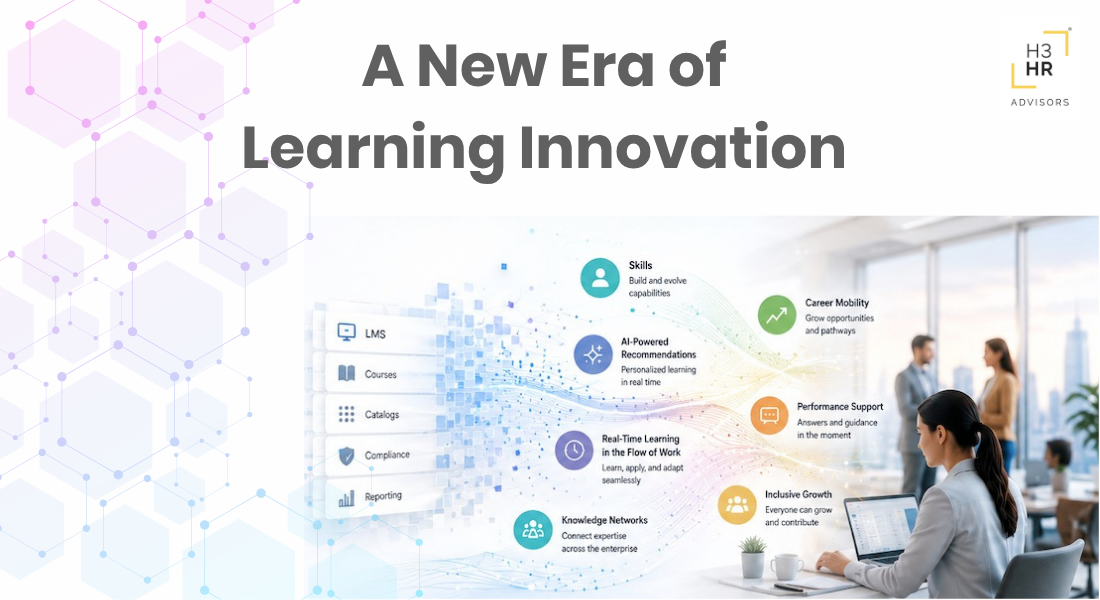
Organizations need talent intelligence and systems that can:
- Understand and map skills dynamically
- Identify gaps at the individual, team, and organizational level
- Recommend and orchestrate development pathways
- Connect learning to career mobility and internal talent movement
- Provide insight into workforce readiness and future capability needs
- Integrate learning into daily workflows and decision-making
In other words, the LMS is not disappearing. It is being subsumed into a broader category that might be better described as workforce capability or workforce intelligence platforms.
This is the space Cornerstone is moving into.
Cornerstone’s Strategic Position: From LMS to Workforce Intelligence Platform
Cornerstone’s history as a leading LMS provider is both an advantage and a potential constraint.
On one hand, the company has deep relationships, a large installed base, and credibility in learning and development. It understands compliance, large-scale content delivery, and enterprise-grade deployment in ways that newer entrants often do not.
On the other hand, that legacy creates perception challenges in a market increasingly focused on skills intelligence, talent mobility, and AI-driven experiences. “Legacy” in enterprise technology sometimes comes with a perception problem, often unfairly.
But to its credit, Cornerstone has not stood still. Over the past several years, it has made a series of moves that signal a broader strategic ambition. The acquisition of SkyHive introduced a robust skills intelligence layer. The company has expanded into career pathing, workforce planning, and talent mobility. Its recent positioning around AI, including its Galaxy AI framework, reflects an effort to reframe the platform as something more than a traditional LMS.
The direction is clear: Cornerstone is evolving from a system that manages learning to one that helps organizations understand, develop, and activate workforce capability.
The key question is not whether this direction is correct. It is whether it is executable as a part of enterprise transformation efforts, which are often challenging even in the most well-intentioned organizations.
The Gap Between Vision and Reality
This is where the earlier discussion on transformation becomes critical. It is one thing to build a platform that can theoretically map skills, recommend development, and support workforce planning while leveraging modern AI capabilities. It is another thing entirely to implement those capabilities inside organizations that are still struggling with foundational issues such as data quality, role clarity, manager development, and employee engagement.
This is the risk facing not just Cornerstone, but the entire category. The gap between what platforms promise and what organizations can adopt continues to widen. This gap creates two competing dynamics:
- Vendors are incentivized to push bold transformation narratives to differentiate in a crowded market.
- Customers are constrained to pursue smaller, targeted interventions that fit within their capacity for change.
The companies that succeed will be those that can bridge that gap most effectively.
What Cornerstone Must Get Right
If Cornerstone is to succeed in this transition, several factors will matter.
First, it must anchor its innovation in real, high value use cases. Workforce readiness, activation, compliance, onboarding, career transitions, and skills gap closure are all areas where customers feel immediate pressure. Abstract AI capabilities will not be enough. Outcomes that can be delivered and measured will be essential to customers. Based on the customer stories shared at their recent Cornerstone Connection in New York City, they are seeing amazing results.
Second, it must prioritize adoption over ambition. The most sophisticated platform in the market will fail if customers cannot implement and scale it. This means simplifying deployment, providing clear pathways to value, and aligning with how organizations operate.
Third, it must demonstrate measurable outcomes. The conversation is shifting from learning activity to business impact. Customers will increasingly expect evidence that investments in learning and development translate into improved performance, retention, mobility, and productivity. And financial and operational measurements like revenue growth and customer satisfaction need to be a part of these conversations.
Fourth, it must integrate learning into a broader system of work. This includes connections to performance management, talent acquisition, workforce planning, and increasingly, the operational systems where work is executed.
Finally, and perhaps most importantly, Cornerstone must help organizations navigate the human side of transformation. Technology alone does not create capability. People do.
Conclusion: Evolution, Not Extinction
Cornerstone’s story is not about defending the LMS. It is about redefining what learning systems must become.
The company is at a genuine inflection point. It has the assets, the customer base, and the strategic direction to play a meaningful role in the next phase of workforce technology. But it is operating in a market where expectations are rising faster than adoption, and where credibility will depend less on vision and more on execution.
The organizations that win in this next phase will not be those that chase the biggest transformation headlines. They will be the ones that build capability deliberately, measurably, and in ways their people can absorb, and can be activated where, when, and how they are needed.
If Cornerstone can align its platform, its messaging, and its customer outcomes around that reality, it will not just remain relevant. It will be an essential partner in enabling their customers to succeed in the new era of work.

How we can help
Led by Trish Steed and Steve Boese, H3 HR Advisors harnesses over 40 years of experience to delivery HCM insights and guidance to global organizations.
H3 HR Advisory services
By leveraging technology, analytics, and our deep industry knowledge we can help you to reposition your workforce and ensure that you have the right people with the right capabilities in the right roles to positively impact the growth of your business.
HR Happy Hour Podcast Network
Created in 2009, The HR Happy Hour Show is hosted by Steve Boese and Trish Steed and is the longest continuously running internet radio show and podcast on Human Resources, HR Technology, Talent Practices, Workplace and Leadership topics.
H3 HR Speaking Services
We work closely with every client to customize your content - keynotes, webinars, research, infographics, and buyer’s guides - to inspire, educate and inform the audience enabling you to reset and realign your organization for a talent-led breakthrough.
Get in touch
Talk to us today and find out how we can help you and your organization leverage HCM technology to attract, onboard, retain and manage top talent.